An Akrotiri Lighthouse proposal, if the meltemi allows
SUNSET 5/5 · PRIVACY 3/5 · WIND EXPOSURE 5/5
The Akrotiri Lighthouse is Santorini's most wind-exposed proposal spot and, on a calm evening, its finest open-sea sunset. The sun drops into water off the cape while the caldera cliffs glow to the north. Check the meltemi forecast first, wear flat shoes for the stony path, and keep candles off the plan.
Five out of five. That is the wind score we give the Akrotiri Lighthouse, the only location on our island map that earns the maximum, and most write-ups bury it beneath the photographs. Out on Santorini's southwest cape there is no village to break the gusts, no wall, no lee; when the meltemi is working, it ends the candle conversation all by itself. Read the number first. Then let the cape argue its way back, because on a still evening it holds the finest open-water sunset the island can produce.
Why does the wind get top billing?
Fig. 1. Meltemi exposure on the planners' one-to-five scale. Akrotiri Lighthouse is drawn at 5 of 5, the only one of the 15 locations we plan at to reach the top of the scale. The tally beneath sets all 15 on that scale: 1 at 1, 7 at 2, 4 at 3, 2 at 4, 1 at 5.
The meltemi is the dry north wind that leans on the Aegean through high summer, peaking in July and August. Most caldera villages take its edge; the cape takes the whole thing. Loose florals, tealights, unweighted signage, carefully arranged hair: a rough afternoon claims all of them, and no planner on the island can veto weather.
So we book this spot against the forecast, not the calendar. We watch the wind through the week, confirm on the morning itself, and hold a fallback inland the entire time. If you are planning solo, copy that discipline, and dress for movement either way; the guide to dressing for the caldera covers fabrics that photograph beautifully in a breeze instead of fighting one.
What the cape gives back
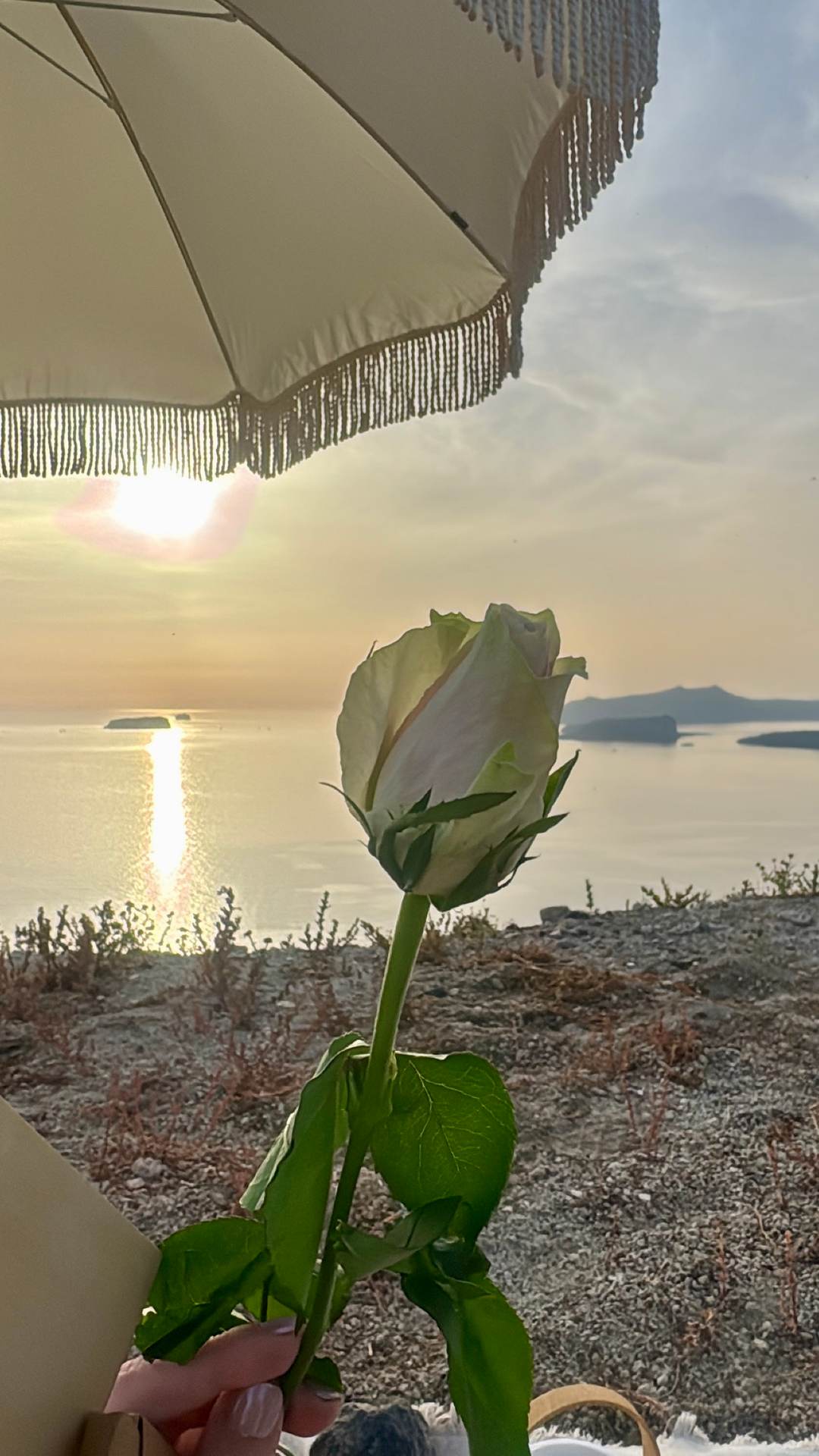
Every rim village watches the sun set toward Thirasia and the caldera mouth. The lighthouse, which locals call simply the Faros, looks past all of that: from its ledges the sun falls into open sea, clean from horizon edge to horizon edge, while the caldera cliffs to the north take the last color like a second performance. No other named spot on Santorini offers a sea-horizon sunset this uncluttered.
The crowd behaves differently here too. A trickle arrives on season evenings, but the ground is broad and people scatter themselves across separate ledges rather than stacking along one rail, so space finds you without being defended. The 19th-century lighthouse stays closed to visitors, which suits a proposal fine: the building is the backdrop, and the two working positions are the south-facing ledges below its wall and the small rise east of the path, where tower and caldera share a single frame.
| Step | When | Field note | Compare |
|---|---|---|---|
| Leave Fira | Sunset −100 min | Roughly half an hour of driving; from Oia allow closer to an hour in season traffic | |
| Park at the cape | −65 min | A rough, unpaved area near the road's end; arrive with enough light to read the ground | |
| Walk the stony path | −60 min | 5–10 min to the viewpoint ledges; flat soles, never leather | |
| Claim a ledge | −50 min | Below the lighthouse wall for pure sea, or the rise to the east for tower and caldera together | |
| The question | −30 min | Sun low over open water, cliffs coloring to the north, warm light still on faces and ring | |
| Walk out, drive to dinner | +20 min | The path is unlit, so use a phone light; Pyrgos and the Megalochori terraces sit 15–20 min by car |
The padding at the front is deliberate. Arriving an hour early costs you nothing except a longer golden hour; arriving late costs the ledge you wanted and a hurried walk over loose stone. Settle the drive home before you need it as well: the cape has no lighting of any kind, the road back is rural, and every version of this evening ends by headlights.
The cape, measured
- Walk in
- 5–10 min from the rough parking area to the viewpoint ledges on a stony path
- The building
- The 19th-century lighthouse itself is not open to visitors; it works as backdrop only
- Wind exposure
- Privacy at golden hour
- Sunset sightline
- Crowd pattern
- A steady sunset trickle in season; the broad cape spreads groups across the ledges rather than stacking them
- Best light
- The sun drops into open water off the cape while the caldera cliffs burn orange to the north
- Plan B
- Pyrgos or a Megalochori winery terrace, both 15–20 min by car
July and August rise or fall on the day's meltemi forecast: a still high-summer evening here is superb, a windy one is unusable.
When the forecast says no
The cape is a conditional gift: on a quiet evening nothing on the island outdoes it, and on a meltemi afternoon nothing rescues it.
Have the alternative chosen before you need it. The south coast sits in the wind's lee, which is why proposing on the south coast pairs naturally with a lighthouse plan as its same-day fallback, and why our own bookings for the Faros always carry a second location in writing. And if what pulled you toward the cape was the absence of an audience rather than the lighthouse itself, where locals would propose maps the island's other quiet zones with the same candor.
A Santorini lighthouse proposal rewards one kind of couple above all: the kind willing to let the weather pick the venue on the morning itself. Give us that flexibility inside a proposal package and we will hand you the cape at its absolute best, or set it against its rivals on the location index and weigh the trade yourself.
Wind, walk and the white tower
How windy does the cape really get?
Windier than anywhere else we stage proposals. The cape takes the meltemi, the dry north wind that peaks in July and August, with no village or wall to blunt it; we score the exposure five out of five. On a forecast-calm evening the air can be nearly still and the light glassy. The working rule: check the wind the same morning, and if it is rising from the north, move the plan rather than fight it.
How long is the walk from parking to the viewpoint?
Five to ten minutes on a stony path from the rough parking area near the road's end. It is short but genuinely uneven; flat soles make it trivial, heels make it a hazard, and after dark it is unlit in both directions. Build the walk into your timing at both ends of the evening, and keep a phone light ready for the return.
Can you go inside the Akrotiri Lighthouse?
No. The 19th-century lighthouse is closed to visitors, so treat the building as scenery rather than a destination. For a proposal that costs you nothing: the ledges below its wall and the rise just east of the path give you the white tower, the open sea, and the caldera cliffs stacked in a single frame, a better composition than any interior could offer.
How crowded is sunset at the lighthouse?
Expect company, not a crush. The cape draws a steady trickle through season evenings, but the ground is broad and people instinctively spread across separate ledges instead of stacking at one rail. Most evenings you can hold genuine space around the question without negotiating for it, which no famous rim viewpoint can honestly offer at the same hour.
Tell us the date. We will hold the light.
One conversation is enough to know whether we are the right house for your proposal. No pressure, no scripts — just an honest read on your dates.
Prefer to write first? WhatsApp us at +30 694 4803339 — a planner replies, not a bot.