A Santorini proposal from the EU, with nothing to file
A Santorini proposal asks nothing of an EU couple on paper: no visa, no license, no file to open before you fly. Only a legal wedding starts a clock — eight to twelve weeks of documents. Everything else about coming from the EU, from the euro to your flight windows, works in your favor here.
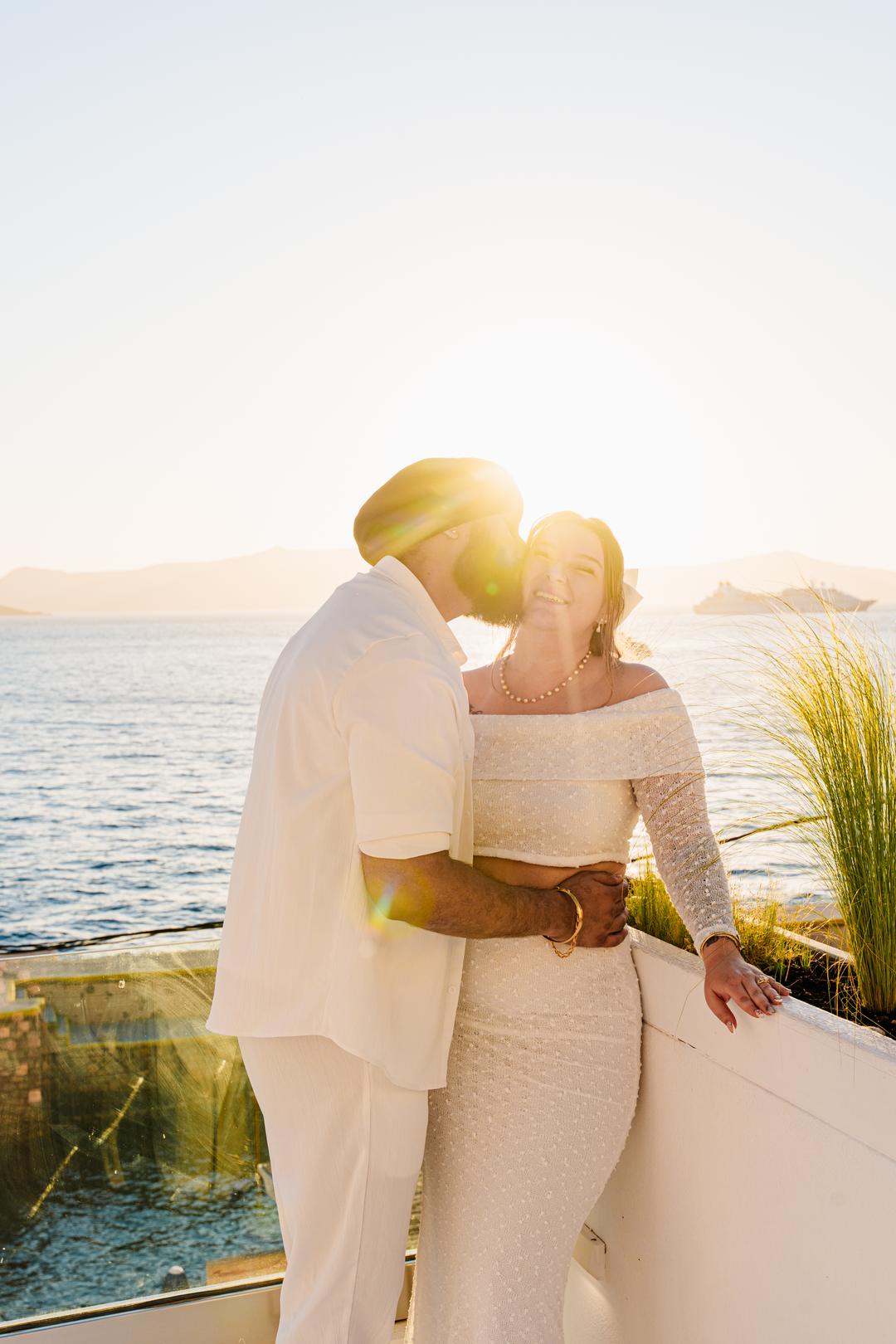
Begin with what you are not doing. You are not applying for anything, translating anything, or waiting on any office in any country to say yes. For a couple based in the EU, this island sits inside your union, inside your currency, and for much of the year inside an afternoon's flying. An ID card gets you through the airport. Your euros spend the moment you land. The consumer protections you lean on at home never switched off, because you never left the market that wrote them. Nearly everything that makes proposing abroad feel administratively heavy is, for you, simply absent.
One distinction organizes the rest of this page, and it is worth fixing before flights or money enter the picture: proposing needs nothing, marrying needs a clock. A proposal has no paperwork, no license, no legal footprint of any kind. It is an evening with a question waiting inside it, and Greece asks exactly nothing of you for the privilege. A legal wedding is a different creature — it runs a document timeline of eight to twelve weeks before anyone says vows that count. Confuse the two and you will plan a proposal with a wedding's anxiety. Keep them apart and the trip relaxes into what it really is: a holiday carrying one enormous minute.

Two clocks, and only one is ticking
Set the proposal and the wedding side by side and the difference is not one of degree. One is a private decision with no administrative existence at all. The other is a legal act with a queue of documents behind it. Nearly every planning question an EU couple sends us from home gets answered faster once it is clear which side of that line the trip sits on.
The proposal
Zero
Licenses, forms, applications, permissions: none exist.
You arrive, you ask, you celebrate. Greece has no opinion.
The legal wedding
8–12 weeks
The document clock, between the first certificate and the municipal license.
Once issued, that license holds for six months.
The question is free. Only the vows are filed.
That asymmetry is the quiet heart of this guide. Nothing about the question obliges you to think like a bureaucrat, and nothing about your citizenship adds a single step to it. Should the answer eventually become a date, the clock on the right is a known quantity — one you can choose to start early, from home, as the last section explains.
How reachable is Santorini from your city?
In season, very. Direct routes connect many EU cities to the island from roughly April through October — the network thickens through high summer and thins toward its edges, and the exact lineup shifts with where you live and which year's schedules you are reading, so check your own airport rather than trusting a generalization. Outside that window, Santorini answers through Athens, which stays connected all year. A winter question is entirely plannable; it simply changes planes once. The practical translation is friendly: if a spring or autumn evening appeals to you, the direct season very likely covers it, and midwinter simply routes through the capital.
The border, meanwhile, is the least dramatic part of the journey. Greece belongs to the Schengen area, so an EU citizen boards with a national ID card or a passport — no visa, no application, no consulate appointment, no waiting for permission to travel to your own engagement. The travel-documents conversation that consumes whole forums for couples flying in from further afield does not apply to you at all.
Geography changes none of the house advice about flying. Choose your week for light and crowds before you choose it for airfare — the month-by-month trade-offs are argued properly in the best-time guide — and land with real slack ahead of the evening that matters, because a delay does not negotiate with a sunset. If an airline disrupts you anyway, EU air-passenger rights under Regulation 261/2004 cover cancellations and long delays, and they are worth knowing by name. But a regulation compensates a journey; it cannot give back an evening. Margin is the only protection that actually protects the plan.

What the euro removes, and what to put in writing
If your account already runs in euros, an entire category of friction never appears. There is no conversion to calculate, no exchange margin hiding inside a card payment, no gap between the number on a quote and the number that finally leaves your account. When you compare what an evening like this costs — and you should compare; the market's honest ranges are set out tier by tier in the cost guide — you are comparing like with like, in the currency your salary arrives in.
The same logic makes printed prices unusually load-bearing. A published figure in euros is, for you, the finished number: nothing drifts between the day you read the packages and the day you pay for one. Couples from outside the eurozone run that arithmetic twice and trust a rate in between. You get to skip the exercise entirely, which is a small luxury that behaves like a large one across months of planning.
Deposits deserve more ceremony than the industry usually gives them. Under EU consumer law, a service bought at a distance comes with the right to clear written terms, so exercise that right as a habit rather than a confrontation. Before any money moves, have on paper: what exactly the deposit secures, the total it counts toward, what happens to the evening and to the payment if weather forces a change, and how cancellation works in both directions. None of this is legal strategy. It is ordinary paperwork that any serious planner produces unprompted — and the speed with which it appears tells you a great deal about how the rest of the collaboration will run.
One quiet habit we recommend regardless of nationality: pay the deposit by a traceable method, keep the written terms with the receipt, and let the paper do its silent work. You will almost certainly never need any of it. That is precisely what good terms are for.


When the question grows into a date
Proposing here commits you to nothing beyond the moment itself, and most couples ask on this island and marry at home. For them, the paperwork story ends before it begins. But some already suspect they will want to return for the vows, and a few want everything on a single journey. That is when the second clock becomes real. A legal wedding in Greece requires a file the proposal never did — certificates gathered at home, translated into Greek, reviewed by the municipality — and the sequence runs eight to twelve weeks end to end. One consolation belongs specifically to you: documents issued inside the EU are spared the extra authentication stamp demanded of papers from further afield. The weddings page walks the whole file, stage by stage, in the order the offices want it, and the civil wedding page sets out where the municipality's authority actually stops.
The license that emerges from the process is the generous part: it stays valid for six months. For an EU couple, that shape creates genuine options. Ask now, then begin the paperwork afterward from your own sofa, on no deadline but yours. Or, if you privately know where this is heading, start the clock well before you fly and let the license be waiting when you land — one journey can then hold both the question and the wedding. What the rule refuses to permit is improvisation. Deciding mid-holiday and marrying legally that same week is not on the table, however certain you both are, because a municipal review does not compress on request. The softer truth is that almost all of the tedium happens in your own country, through your own records offices, before a single bag is packed.
There is also a middle road worth naming, because it suits the same-trip instinct without touching the clock at all: a symbolic ceremony. It carries no Greek paperwork and no legal standing — the vows are real, the file is not — and couples who choose it hold the celebration here and complete the legal step at home, in whichever order suits them. It is not a lesser wedding so much as a different filing cabinet.

Planning calls that fit inside a workday
One further advantage never makes the brochures, because it is too ordinary to photograph: the clock on the wall. Santorini keeps time at the eastern edge of the EU, so your office hours and ours genuinely overlap. A question sent with your morning coffee is read during ours. A decision made in your afternoon is confirmed before our evening closes. Nothing has to wait for the planet to turn — there is no rhythm where every answer arrives while you sleep and every reply leaves while we do.
Across a full planning cycle, that overlap compounds. The scouting questions, the quote, the run-through of the timeline, the final weather call — every exchange lands in shared daylight, which keeps momentum in a way couples planning from the far side of the planet have to fight for. Administratively speaking, you are arranging an evening in the next city over, and it is healthy to treat it exactly that way. When you are ready to build the evening itself — the week, the spot, the exact minute of the asking — the whole sequence is laid out in the how-to guide and none of it changes with the passport you carry. The paperwork was never going to be the hard part for you. The hard part is the same as it is for everyone: keeping the secret until the light is right.
Border, euro and clock questions
Do EU citizens need a visa or any paperwork to propose in Santorini?
No visa, and no paperwork of any kind. Greece is a member of the EU and the Schengen area, so you travel on a national ID card or a passport and nothing else. The proposal itself has no legal existence: there is no license to request, no office to notify, no residency condition, no form with your names on it. You book a trip, you carry a ring, you ask. The only version of this island that wants documents from you is a legal wedding, and that is a separate decision with its own timeline.
What should we get in writing before paying a deposit to a proposal planner?
Ask for the terms before you pay, not after. In writing: what the deposit secures, the total price it sits against, what becomes of the evening and the money if weather intervenes, and how cancellation runs in either direction. EU consumer law expects clear written terms when you buy services at a distance, so a planner accustomed to European couples will hand them over without being chased. Treat the speed of that document as part of the audition. A quote that arrives without its terms attached is telling you how the rest of the relationship will run.
Does paying in euros make a Santorini proposal simpler to plan?
If you live in the eurozone, yes, in a quiet way that compounds. The price on a quote is the price that leaves your account: no conversion, no exchange-rate margin, no card surprise weeks later when the statement lands. Quotes from different planners compare directly, because they are written in the money you think in. Budgeting stops involving a currency app. And if a refund is ever owed, it comes back in the same euros it left in. None of this makes the island cheaper. It makes the numbers honest at first glance, which is rarer than it should be.
When do direct flights from EU cities reach Santorini?
Broadly with the season. Direct routes from many EU cities run from roughly April to October, densest in high summer and sparser at either end. Outside that window the island stays open through Athens, which connects year-round, so a winter or early-spring proposal is a connection rather than a compromise. Schedules firm up at different times for different airlines, so check your own city's routes before you set the week, and whatever you fly, land early enough that a delay costs you sleep, not the moment. EU air-passenger rights cover cancellations and long delays; they cannot re-stage a sunset.
Could we turn the same Santorini trip into a legal wedding later?
You can, if you respect the asymmetry. The proposal needs nothing, so nothing stops you from asking this spring and deciding the rest afterward. A legal wedding in Greece starts a document clock of eight to twelve weeks, and the license it produces stays valid for six months — generous enough that couples who begin the paperwork early can marry on a return trip, or, with real foresight, on the same one. If there is any chance your question becomes a date, read the wedding requirements before you travel and start gathering certificates at home. That is planning, not law; for the law itself, the municipality has the final word.
Tell us the date. We will hold the light.
One conversation is enough to know whether we are the right house for your proposal. No pressure, no scripts — just an honest read on your dates.
Prefer to write first? WhatsApp us at +30 694 4803339 — a planner replies, not a bot.