Engagement spots, scored for the camera
The best Santorini engagement spots are chosen for light and backdrop variety, not secrecy — a session welcomes the audience a proposal hides from. Morning side-light, walkable village pairs, and honest crowd hours outrank any private terrace here. We re-read our own location scores through the camera and say plainly where the weighting changes.
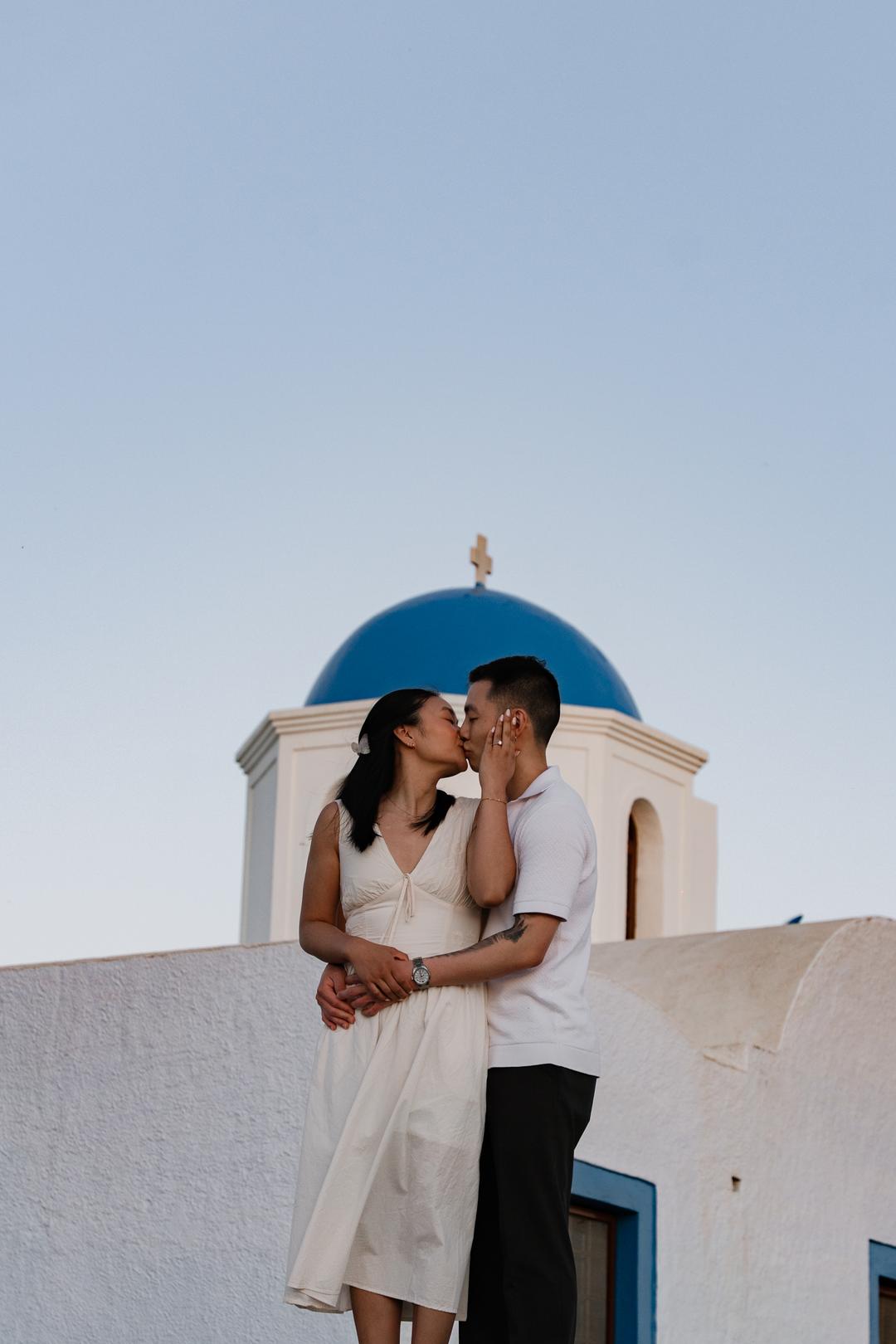
This page takes the same fifteen locations as the proposal register and scores them for a different job. A proposal needs one perfect vantage, held in secret, for a single minute. An engagement session needs a route: changing backdrops, light that keeps developing, and room for a photographer to work openly. So the weighting shifts, and we state it plainly — privacy counts for less here, because nobody is hiding. What the proposal register calls a privacy problem, a session calls an audience of extras. Light, backdrop variety, and the practical business of shooting in public count for more.
Below: four numbers from the register re-read through a viewfinder, then the village-to-village pairings that give a camera the most island per hour. Once the where is settled, the session-design page handles the how, and the engagement ideas page handles the day wrapped around it.
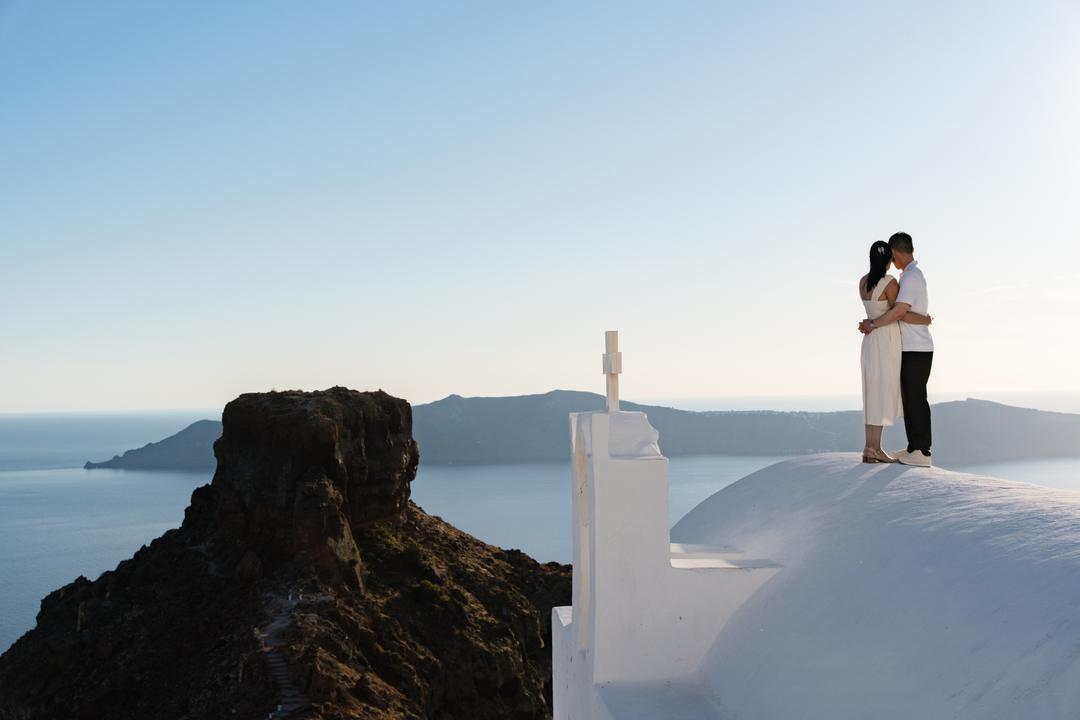
Four register numbers, re-read
Privacy 1 of 5, re-read: the crowd becomes scenery
The Three Blue Domes viewpoint holds the register's lowest privacy score, a 1 of 5, and Oia sits at 2. For a sunset proposal those numbers are close to disqualifying. For a session they nearly stop mattering: you are visibly being photographed, passersby read the situation and move along. What survives the re-read is frame discipline — the micro-spots that keep strangers out of the shot, since they no longer need keeping out of the moment.
Wind 5 of 5, re-read: movement first, then a limit
The Akrotiri lighthouse cape scores 5 of 5 for wind exposure, the register's harshest, and that score ends candlelit proposal plans outright. Through a lens, moderate wind flips into an asset: hair and fabric in motion photograph alive, where stillness photographs posed. Oia's 3 and Firostefani's 2 sit in the sweet band. A true 5 stays a limit even for a shoot — past a point the gusts fight your gear, your dress, and your eyes.
300 steps, re-read: the descent is a shot list
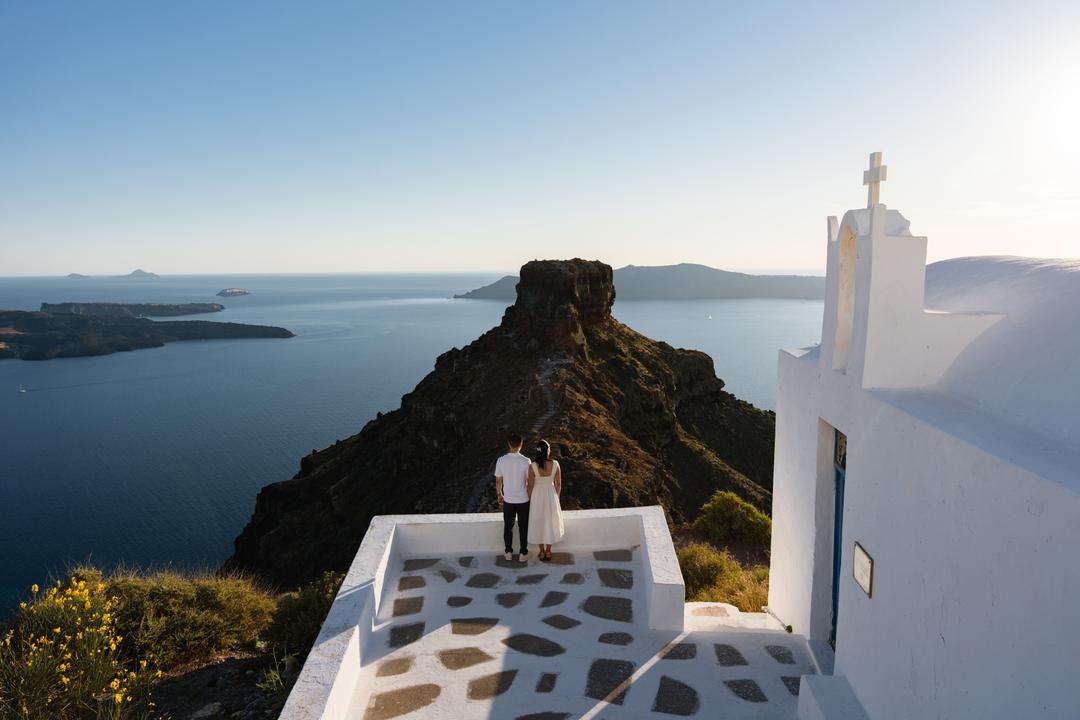
The register prices Ammoudi Bay honestly: roughly 300 slate steps down from Oia's castle end, 20–25 minutes climbing back. As proposal logistics, that is sweat in evening clothes. As a session, the staircase is the location — the frame changes at every switchback, from windmill line to red cliff to harbor water. The same inversion upgrades Imerovigli's 15–20 minute walkway out to the Skaros saddle from an effort cost into a moving set.
The last 40 minutes, re-read: one hour is not a verdict
A proposal buys a single minute of light; a session shoots the whole curve. Oia's register entry names two windows — the final 40 minutes for gold on the whitewash, and 06:00–07:30 for empty lanes in soft pink. At the Three Blue Domes, morning side-light from 07:00 to 09:00 models the churches, while golden hour flattens them into silhouette. For a camera, morning is not the fallback. It is frequently the answer.
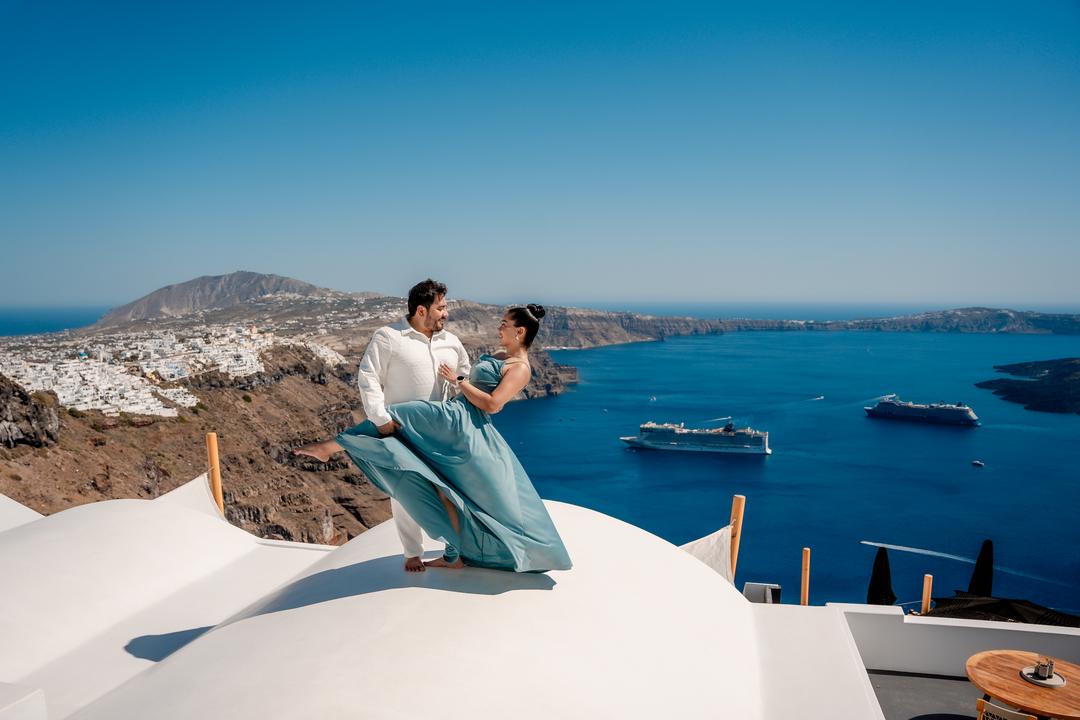
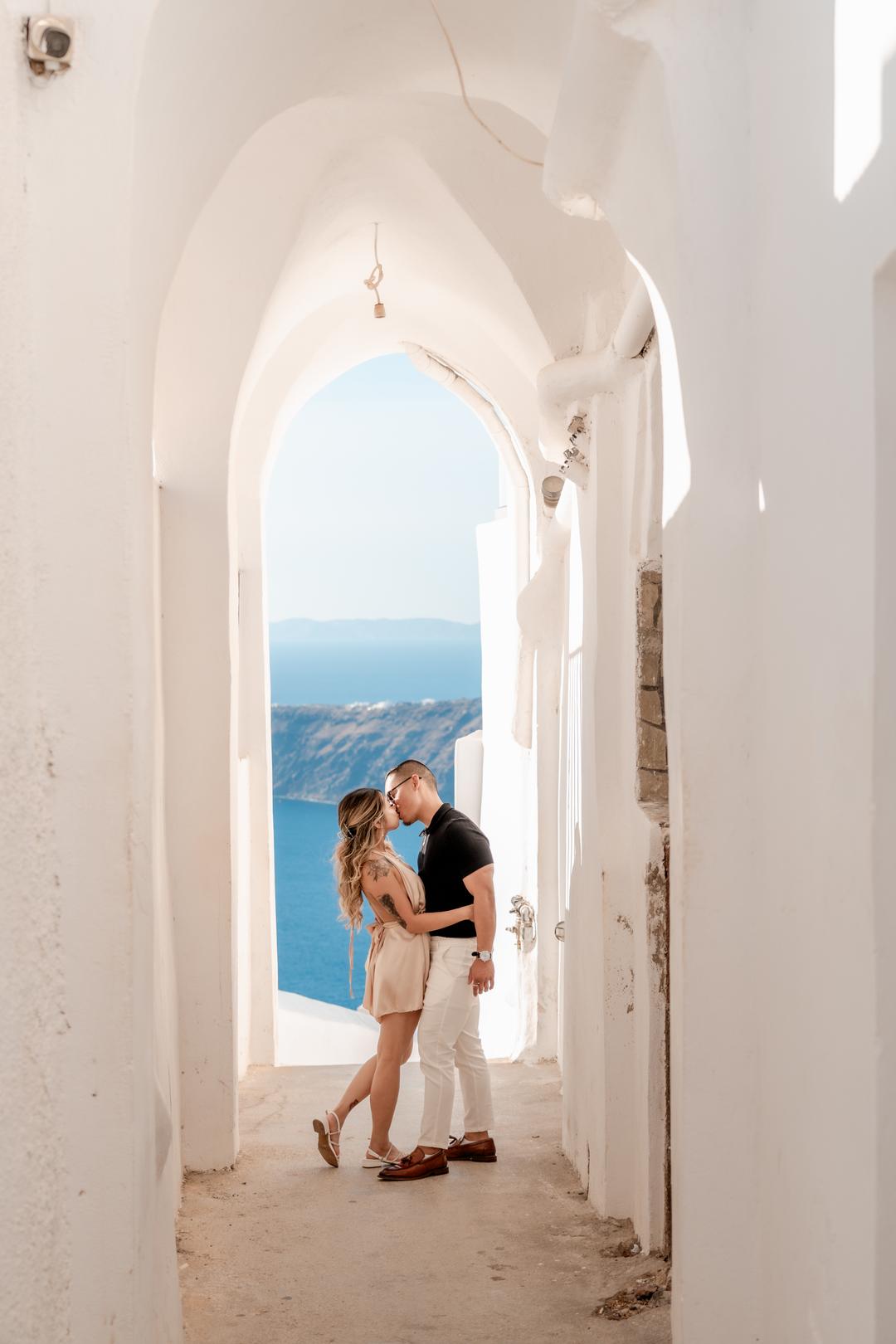
Which routes chain the most backdrops in one session?
Three pairings fall straight out of the register's own walking distances. Fira to Firostefani is a 10–15 minute level path, and Firostefani's entry points another 20 minutes north to Imerovigli — one continuous arc from capital bustle past the postcard dome to the rim's highest village, the light warming as you go. Oia's lanes down to Ammoudi turn that slate staircase into a working descent and finish at the only major spot where the setting sun meets the water at eye level, with the red cliffs above holding color after the drop. Inland, Pyrgos pairs with a winery terrace ten minutes downhill: medieval stone shade first, then a west-facing deck over the open caldera mouth and a glass of assyrtiko catching low sun for the signature frame.
Each pairing moves in one direction, repeats no backdrop, and ends where the evening light is strongest. The craft of running one — pacing, the single outfit change, the finale through dusk — belongs to the engagement photoshoot page; this page's only job is to show where the island offers a route rather than a viewpoint.
Shooting the island: the practical questions
Do we need permission to shoot at these spots?
A couple and one photographer moving along a public path need nobody's blessing anywhere on the island. Organized shoots at protected and archaeological sites can require permission, and anything that plants equipment on a narrow lane is drifting from a walk toward an event. Churches are working churches: photograph the exteriors from public ground, and never climb onto roofs or private steps. Private terraces, hotels, and wineries each set their own rules — the honest procedure is simply to ask the venue before you arrive.
Which spots work at which hour for photography?
Read the register's light strings as a shooting schedule. Oia gives soft pink light and empty lanes from 06:00 to 07:30; the Three Blue Domes take their best side-light between 07:00 and 09:00. The final hour belongs to the west-facing spots: warm side-light on Firostefani's dome, the last 40 minutes of gold on Oia's whitewash, the last 30 turning Skaros rust-red. After dark, Fira is the one village whose rim lights keep a session alive.
Can we bring a tripod, an assistant, and lighting?
You can — the question is where the session stops reading as a stroll and starts reading as a production. One photographer working handheld passes unnoticed everywhere. A tripod holding a position for two hours is precisely what the register's Three Blue Domes crowd note describes, and it earns the same resentment; add stands, an assistant, and a wardrobe rack, and shared paths start asking questions a walking couple never gets. Keep public-ground setups light and mobile, and stage anything heavier on ground a venue has agreed to.
When are these places actually empty enough for a session?
The register's crowd language, re-read for shoots, points one direction: early. Oia's castle terraces run shoulder-to-shoulder from an hour before sunset, yet the same lanes are yours at half past six in the morning. Firostefani's dome viewpoint turns over fast even at golden hour, Vlychada's far end is often empty in the day's last light, Fira's northern path clears after 21:00, and Pyrgos draws a trickle even in August. For open frames in good light, morning has no competitor.
Which spots photograph better than they look in person — and the reverse?
The Three Blue Domes are the honest extreme: in person, a narrow shoulder of public path; in frame, the angle the whole world recognizes. Vlychada's wind-carved white cliffs outperform the same way — modest on arrival, sculptural through glass. The reverse also exists: the caldera from the Skaros saddle overwhelms in person in a way wide lenses flatten, and the lighthouse cape's clean horizon feels bigger under your feet than it reads in a print. Shoot the overperformers; save the underperformers for simply standing there.
Tell us the date. We will hold the light.
One conversation is enough to know whether we are the right house for your proposal. No pressure, no scripts — just an honest read on your dates.
Prefer to write first? WhatsApp us at +30 694 4803339 — a planner replies, not a bot.