Guide · Composite evenings

Five evenings, and what each one was built from

These Santorini proposal stories are composite evenings, not named couples. Each is built from the real clock, wind score and walking time the island imposes that month, so they show how an evening is engineered rather than luck. Real couples' stories will replace them as permissions arrive.

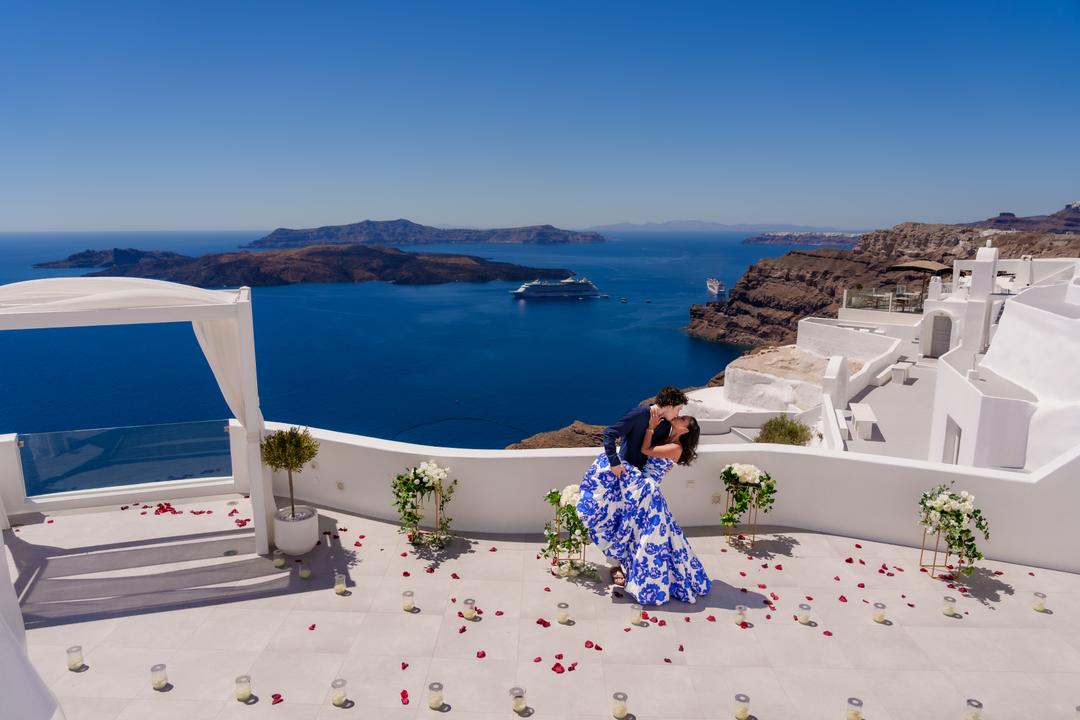
A white terrace seen from above, a couple kissing at its far edge with the caldera and the volcano beyond

Read this first: none of the five couples below exists. These are composite evenings — assembled from the shape of many, told with no name, no face and no quote belonging to any real person. What is real is everything measurable in them: the sunset minute, the arrival time, the wind score, the length of the walk. We would rather show you the engineering honestly than invent a testimonial, and this page is written to be replaced the moment real couples give us permission to tell theirs.

An evening on this island is mostly arithmetic wearing a good coat. The light arrives at a knowable minute, the crowd thins at a knowable hour, the wind either permits the plan or it does not, and the walk either fits the shoes or it does not. What follows is five of those arithmetics, each with its inputs printed beside it, so you can see which of the four variables did the work.

What does a planned Santorini evening actually look like?

Evening one
Month
Late September
Place
Imerovigli, the Skaros saddle
Sunset
19:30 · in position by 18:15
Wind · privacy
3 of 5 · 4 of 5
The walk
15–20 min, one stepped section

The one that needed the walk to be part of it

They wanted somewhere the two of them would have to arrive at rather than be delivered to. The saddle below Skaros qualifies: a caldera walkway, then a stepped section that makes trainers the honest choice, and a scoring of four out of five for privacy that holds even in September because most people stop at the viewpoint above and photograph the rock instead of walking out onto it.

The clock did the planning. September's sun goes at 19:30 and the light starts turning at 18:35, so the position had to be held by 18:15 — which meant leaving the room at 17:45 and building in the fifteen minutes people always lose to the last shop. The photographer went ahead and settled on the higher path with a long lens, which on that saddle reads as somebody photographing the rock.

What made it work was the afterglow. The question came four minutes after the drop, and the color held until 20:00, so the half hour afterwards — the part nobody plans and everybody remembers — happened in full light with nowhere to be.
Evening two
Month
June
Place
Pyrgos, the Kasteli hilltop
Sunset
20:40 · in position by 19:25
Wind · privacy
2 of 5 · 4 of 5
The walk
10–15 min climb, medieval lanes

The one that refused the caldera

He had decided early that he did not want the postcard. Every image he had been sent looked like the same blue dome with different people in front of it, and he wanted the photographs to be identifiable as theirs rather than as Santorini's. Pyrgos answers that: a hill village inland, a climb through lanes that were laid out for defense rather than for views, and a wind score of two where the caldera rim gives you three.

June is the island's most generous month for a late plan — sunset at 20:40, color holding to 21:15 — and the most crowded everywhere the buses go. Pyrgos is not where the buses go at that hour. The village is busy at lunch and quiet at eight, which inverts the usual advice and is the whole reason it works.

The climb was the risk and became the point. Fifteen minutes of steps in June heat is not romantic in the moment, and she said so twice. They came out onto the hilltop with the whole island laid flat underneath and the sea going gold on three sides, and the argument about the steps ended mid-sentence.

Evening three
Month
May
Place
Akrotiri Lighthouse — abandoned
Sunset
20:20 · in position by 19:05
Wind · privacy
5 of 5 · 3 of 5
The walk
5–10 min over rough ledges

The one that did not happen where it was supposed to

This is the evening we include because the other four make the island look obedient. The lighthouse headland is the most cinematic ground on Santorini and it scores five out of five for wind, which is not a warning we attach to anything else. Five means the meltemi can stand you up sideways and take a ring box out of an open hand.

At 16:00 the forecast turned and the call was made four hours before the question. That is the whole trick, and it is not a trick: the decision point sits early enough that moving costs a phone call rather than an evening. The backup had been booked at the same time as the first choice, on the sheltered side, twenty minutes away.

They proposed at 20:24 on a low terrace out of the wind, with the sea flat and the sky doing what May skies do. He told us afterwards that he had spent three weeks attached to the lighthouse and about ninety seconds letting go of it. Nobody who saw the photographs has ever asked where the first plan had been.

Evening four
Month
February
Place
A private caldera terrace
Sunset
18:05 · in position by 17:00
Wind · privacy
3 of 5 · 5 of 5
The walk
None — step-free, indoors to terrace

The one in the empty season

February is the month we are asked about least and defend most. The island is closed in the way an island is closed — a handful of restaurants, no queues anywhere, and the rim genuinely empty. Sunset falls at 18:05, which means the whole thing is finished before dinner rather than instead of it.

The weather is the trade. February produces either a flat grey lid or the most violent color of the year, and there is no forecast that will tell you which four days out. They took that bet knowingly, with a terrace that scores five for privacy and does not care what the sky does, and a plan that worked in both directions: if the light came, they were outside; if it did not, the same terrace has a door and a fire behind it.

The light came. It came in the way winter light does here, all at once and briefly, and it was over eleven minutes later. They were engaged inside that window with nobody else on the rim for several hundred meters in either direction, which in August is not purchasable at any price.

Evening five
Month
October
Place
Ammoudi Bay, at the water
Sunset
18:45 · in position by 17:40
Wind · privacy
2 of 5 · 3 of 5
The walk
About 300 slate steps down, 10–15 min

The one that went down instead of up

Almost everybody proposes looking down at the water. This one happened beside it. Ammoudi sits at the foot of Oia's castle end, roughly three hundred slate steps below the village, and the steps are the reason it stays quieter than the walkway above at the same hour.

Going down is the easy direction and the wrong one to underestimate: the slate is polished by two centuries of use and by the donkeys that still work it, and in October it can be wet in the late afternoon. They went down early, slowly, with the light still high, and had forty minutes at the bottom before anything was supposed to happen.

The frame is the opposite of the postcard — red cliff going up rather than blue sea going down, fishing boats, the water very close. October sunset is 18:45 and the color held to 19:15, and they ate at the bottom afterwards rather than climbing back up in the dark, which is the single piece of advice this evening exists to give.

Every figure above is quoted from the published sunset table and from the one-to-five location scores used across the locations index. Nothing in these five was rounded to make a better sentence.

Which of the four variables should decide your evening?

Read the five ledgers side by side and the pattern is hard to miss: no evening was won by the location alone. Two were decided by the month, one by the wind, one by the walk, and one by a decision made four hours early. If you are choosing between spots and finding it impossible, it is usually because you are comparing them on the one variable that matters least.

The practical order is the order the ledgers print in. Fix the month and you have fixed the clock, the crowd and half the price. Then choose the ground, knowing what its exposure score means. Then decide honestly what walk you want to be doing twenty minutes before the question — that answer eliminates more options than any view ever will. A planner is largely someone who asks you those three in that order and then holds the margins.

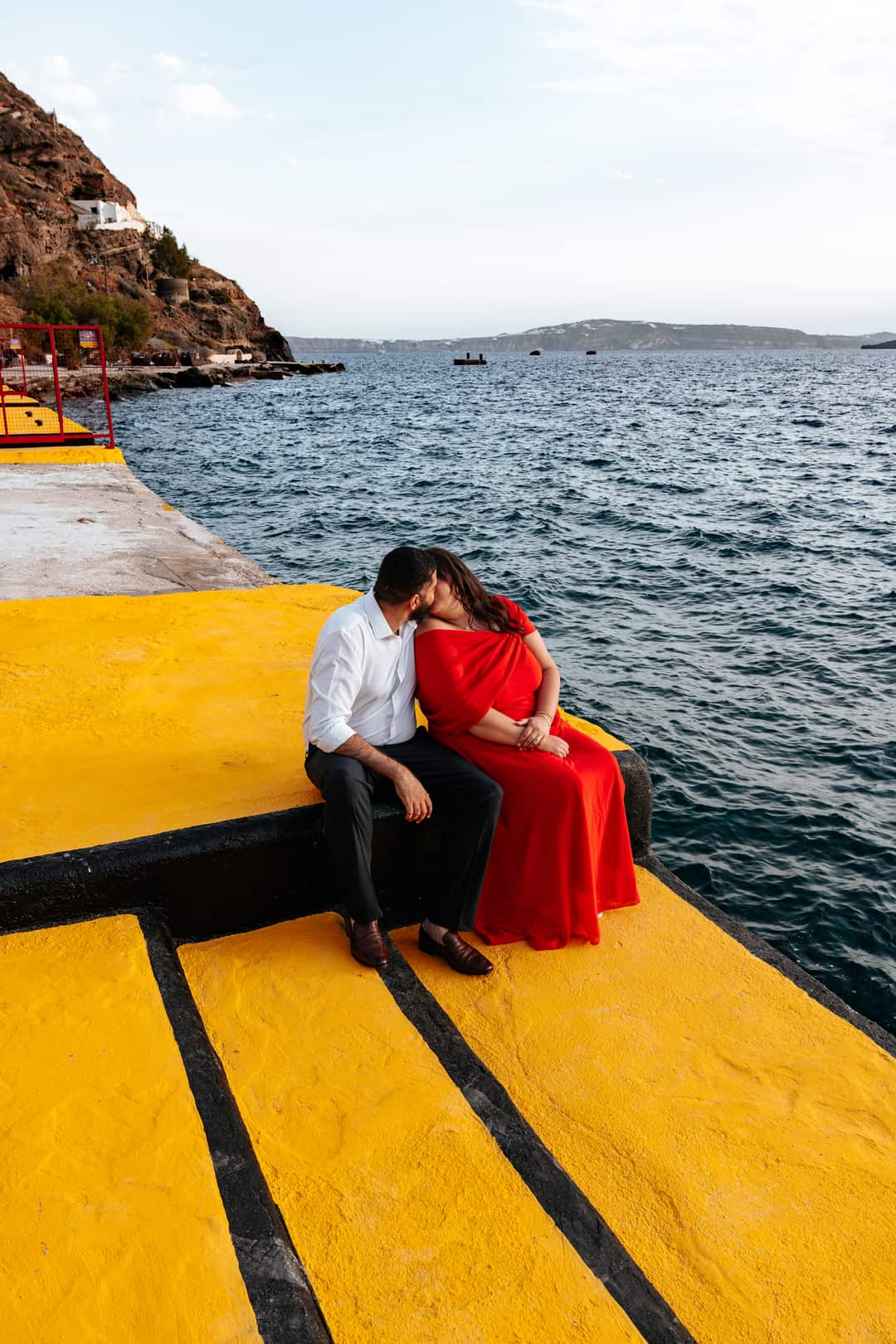
A couple sitting on a painted yellow jetty above dark blue water, a cliff and a small harbor behind
Ammoudi, at the water rather than above it.

About these five evenings

Why are these composites instead of real couples' stories?

Because we do not have written permission to tell any particular couple's evening yet, and a proposal is the most private thing we are ever handed. Publishing a real one without a signed release would be a strange way to prove we can keep a secret. So these five are assembled from the parts of many evenings — the month, the light, the walk, the thing that went sideways — with no name, no face and no quote belonging to anyone. Every number in them is real and traceable; only the couples are not. When releases arrive, real stories replace these, and we will say so on the day it happens.

Can you recreate one of these evenings exactly for us?

The structure, yes. The evening, no, and you would not want it to be. What transfers is the engineering: the arrival margin, the sightline check, the position of the person holding the camera, the order the beats run in. What cannot transfer is the specific — a September light that behaved a particular way, a lane that happened to be empty at ten past seven. Tell us which of the five you are drawn to and why, because the why is the useful part. Usually it turns out to be one thing: the privacy, the drama, the quiet, or the fact that nobody had to climb anything.

What actually changes between one Santorini evening and another?

Four variables carry almost all of it, and they are the four printed in each ledger below. The month sets the clock — sunset moves more than three and a half hours across the year, so a June plan and a December plan are different evenings with the same words in them. The location sets the crowd and the exposure. The wind score decides whether the plan or the backup runs. The walk decides what shoes are honest and how much margin the arrival needs. Everything else is preference.

If we hire you, will our proposal end up on this page?

Not unless you ask us to, in writing, after the fact. The default is that nothing about your evening is published: no photograph, no location, no date, no mention. We do not ask for a release in the booking paperwork, because agreeing to be marketed is a poor thing to sign while you are excited about something else entirely. If you decide months later that you would like your evening told, we will be glad to. If you never mention it again, that is the expected outcome and no one will chase you.

Do the wind and sunset figures on this page come from somewhere real?

They come from the same two files every page here quotes. The sunset, golden-hour and afterglow minutes are the monthly averages published on our sunset times page. The wind and privacy scores are our own one-to-five planner ratings for each location, applied consistently across the whole site rather than tuned per page. That is why the Akrotiri evening below reads the way it does: that headland scores five of five for wind, and no amount of wanting it to be calm changes the number.

Tell us the date. We will hold the light.

One conversation is enough to know whether we are the right house for your proposal. No pressure, no scripts — just an honest read on your dates.

Prefer to write first? WhatsApp us at +30 690 0101100 — a planner replies, not a bot.

Plan my proposalWhatsApp