A commitment ceremony in Santorini, on its own terms
A commitment ceremony in Santorini creates no legal marriage and seeks none anywhere else either. That single intention separates it from a symbolic wedding, where a legal marriage exists at home. Everything visible on the day is identical, and the ceremony is written entirely by the two people holding it.
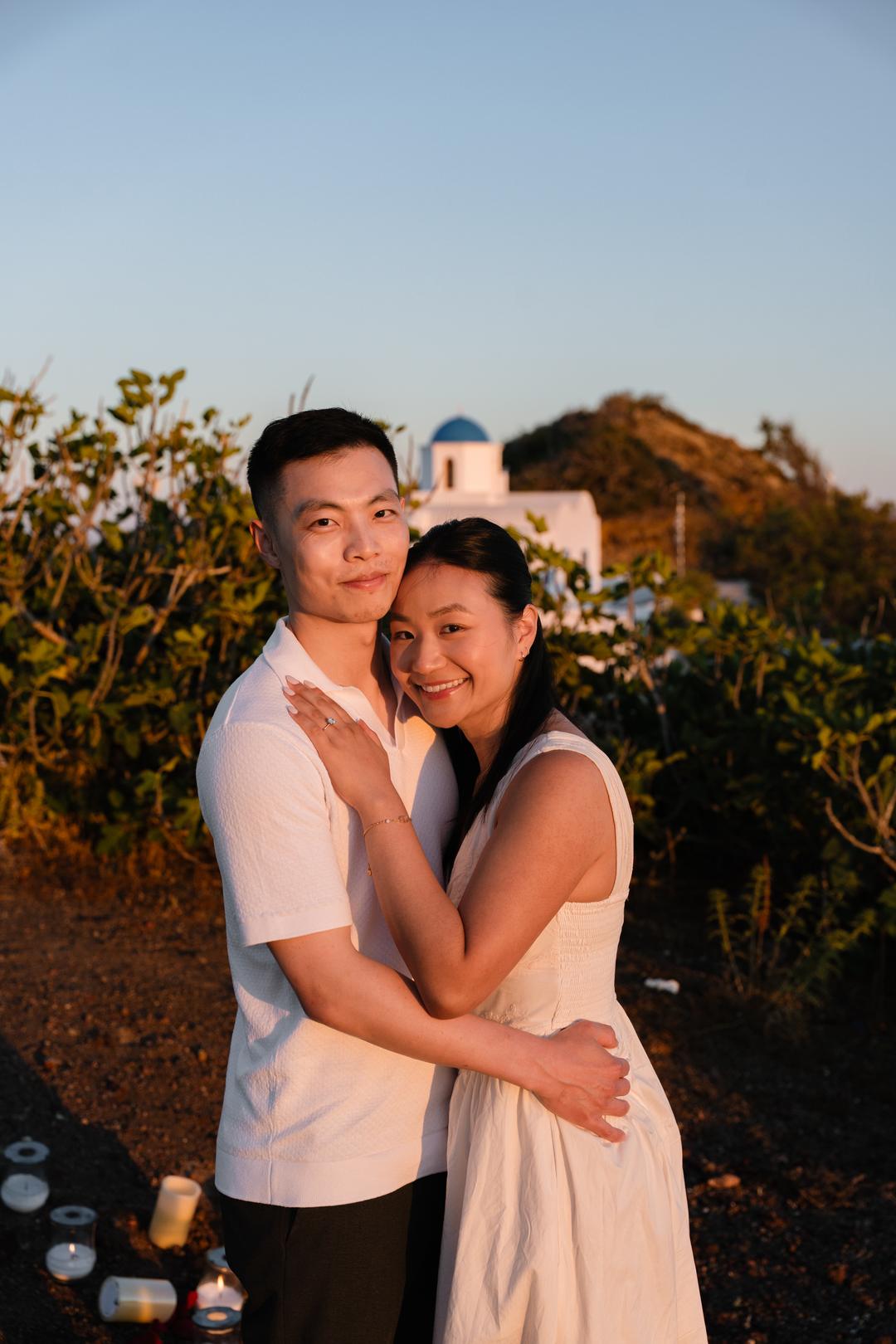
This is the ceremony the industry is worst at describing, usually by describing it as a lesser version of something else. It is not a rehearsal, a blessing, or a wedding with a piece missing. It is a complete ceremony whose meaning is conferred entirely by the people standing in it, and for a good number of couples that is not a compromise but the entire point.
What separates this from a symbolic wedding?
One question, and only one. Everything else about the two days is interchangeable.
Is there a legal marriage, anywhere?
Yes, at home
You want a symbolic wedding. The island holds the meaning; a registry somewhere holds the file.
No, and none is sought
You want a commitment ceremony. Nothing is filed anywhere, by design, and the day answers to nobody.
Naming it correctly is worth the thirty seconds it takes, because the two ceremonies are planned identically but talked about differently. A couple holding a symbolic wedding is usually managing a family's expectations about a legal date. A couple holding a commitment ceremony is usually managing a family's expectations about whether one is coming. Those are different conversations, and knowing which one you are in shapes how we brief a celebrant.
What the day is actually built from
Without an official to schedule or a venue to have approved, the planning inverts. A legal ceremony is built outward from a fixed appointment; a commitment ceremony is built backward from the light, which on this island is the only authority that keeps time reliably. That means the hour is chosen first, then the setting that suits it, then everything else.
It also means the settings open up considerably. Anywhere we can reach and light is available to you, including places a municipal official would never be asked to attend. Couples who care about privacy above all tend to end up here for exactly that reason, and the practical planning then looks a great deal like a two-person elopement with a different name on it.
Couples already married who want the ceremony rather than the status are describing a vow renewal, which is a different page and a different evening. The commercial side does not change: the ceremony type is a configuration inside a package, and the three wedding floors apply whichever you hold. What falls away is the document handling, because there is no file to handle. The setting question stays exactly as open as it is for any ceremony — a cliff, a terrace, a boat — though when a couple wants the water at arm's length rather than six hundred feet down, we stage it at AION on the Old Port, the venue in the photographs below.
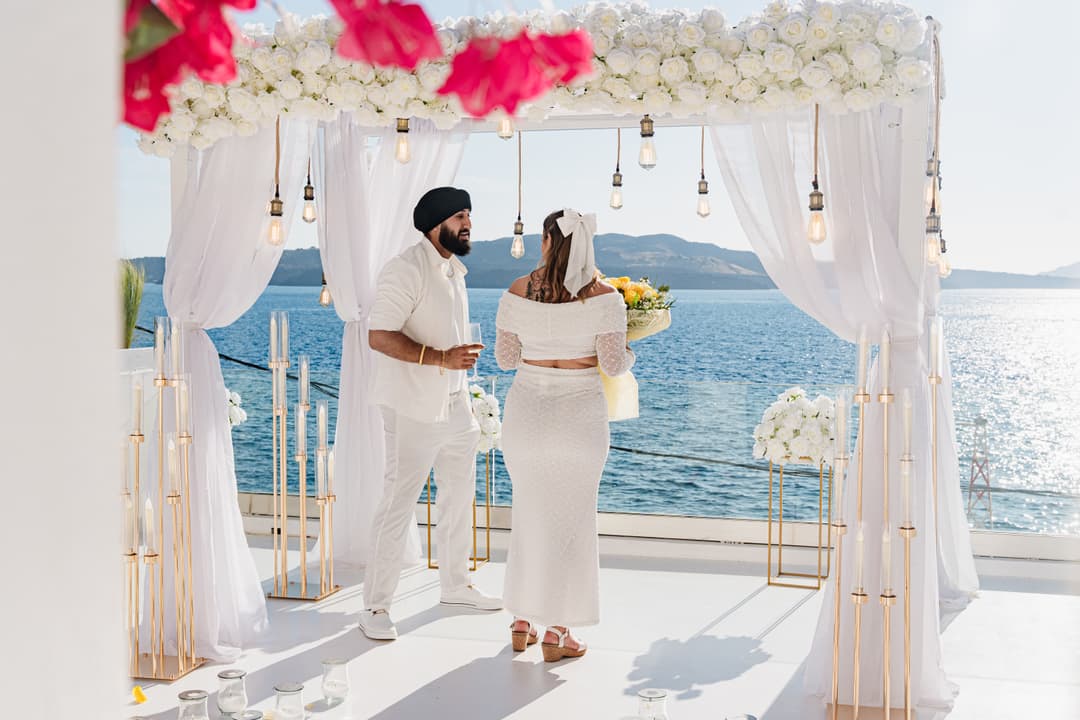
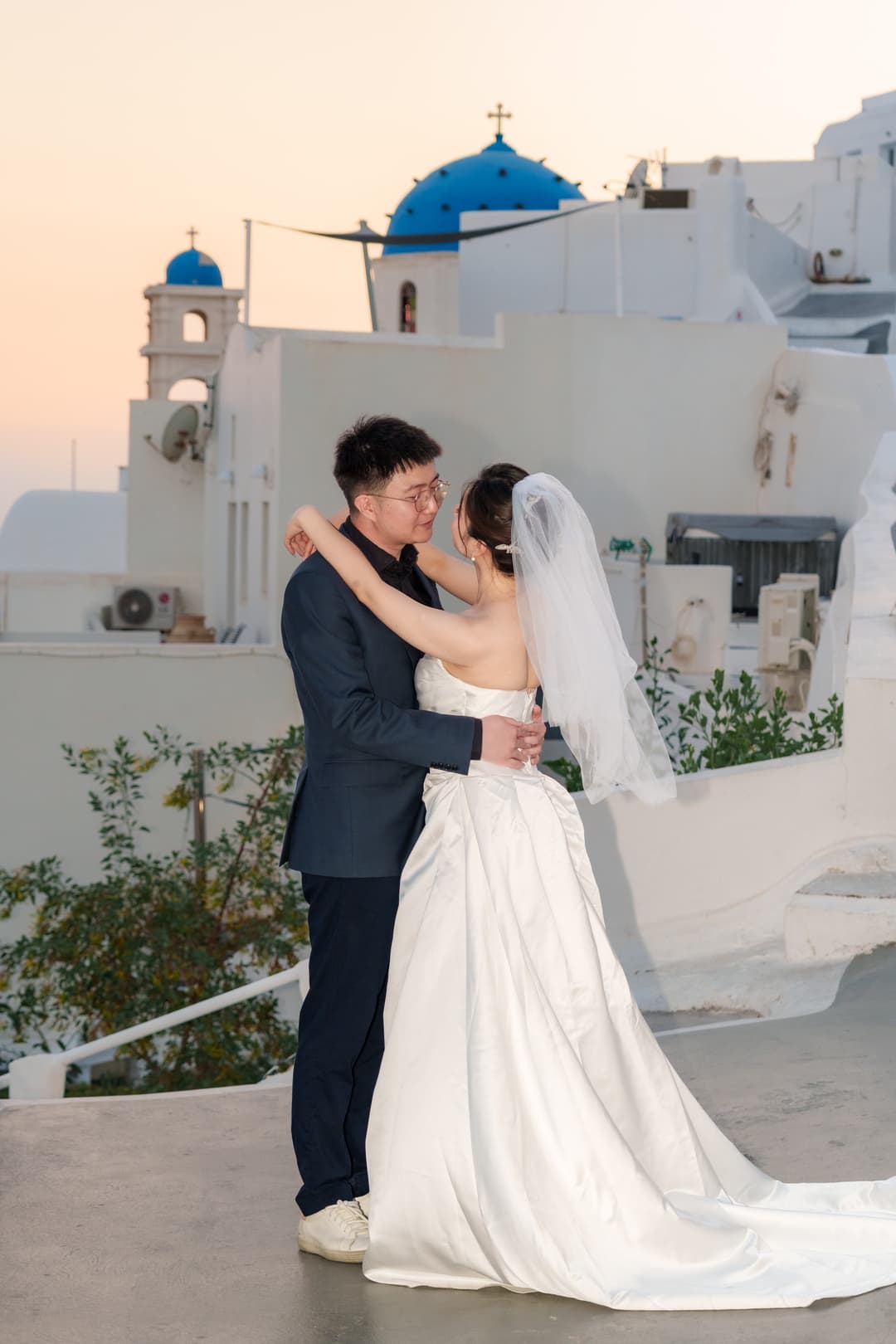
Tell us what you are actually planning
There is no checklist to send for this one, which is the whole point of it, so this form asks a different question. Tell us who is coming, what you want said, and whether anyone in the picture is expecting a legal date they are not going to get. That last one is not nosiness. It is the thing that most often needs planning around, and it is easier handled in June than on the terrace.
Commitment ceremonies, without hedging
How is this different from a symbolic wedding?
Only in intention, and the difference matters more than it sounds. A symbolic ceremony accompanies a legal marriage that exists somewhere, usually at home. A commitment ceremony accompanies no legal marriage at all, because the couple is not seeking one. Nothing a guest sees differs. What differs is the answer to a single question about paperwork that exists in another country.
Who chooses a commitment ceremony?
Couples who have decided marriage is not the structure they want, couples for whom legal marriage is unavailable or unequal in their own country, and couples who married quietly years ago and want the ceremony they never had. Those three groups want different days, and the only thing they share is that no registrar is involved on any continent.
Can we still have a celebrant, rings and readings?
All of it, and with more latitude than a legal ceremony allows, because no official has fixed words that must be spoken. The celebrant works from what you write. Rings, readings, music, witnesses and a signed keepsake certificate are all normal, and the keepsake is understood by everyone present to be exactly that rather than a legal instrument.
Where can a commitment ceremony be held?
Anywhere on the island we can reach and light, since there is no municipal approval to obtain and no official to schedule. That opens settings a legal ceremony cannot use: a boat at anchor, a cliff path before the village wakes, a private terrace with four people on it. The constraint becomes wind and light rather than bureaucracy.
Tell us the date. We will hold the light.
One conversation is enough to know whether we are the right house for your proposal. No pressure, no scripts — just an honest read on your dates.
Prefer to write first? WhatsApp us at +30 694 4803339 — a planner replies, not a bot.