A Greek Orthodox wedding in Santorini, and what it asks first
A Greek Orthodox wedding in Santorini is a legally binding marriage, and it asks more of a couple than the civil route does. At least one partner must be baptized Orthodox, and the church requires its own documents stacked on top of the full civil set rather than instead of it.
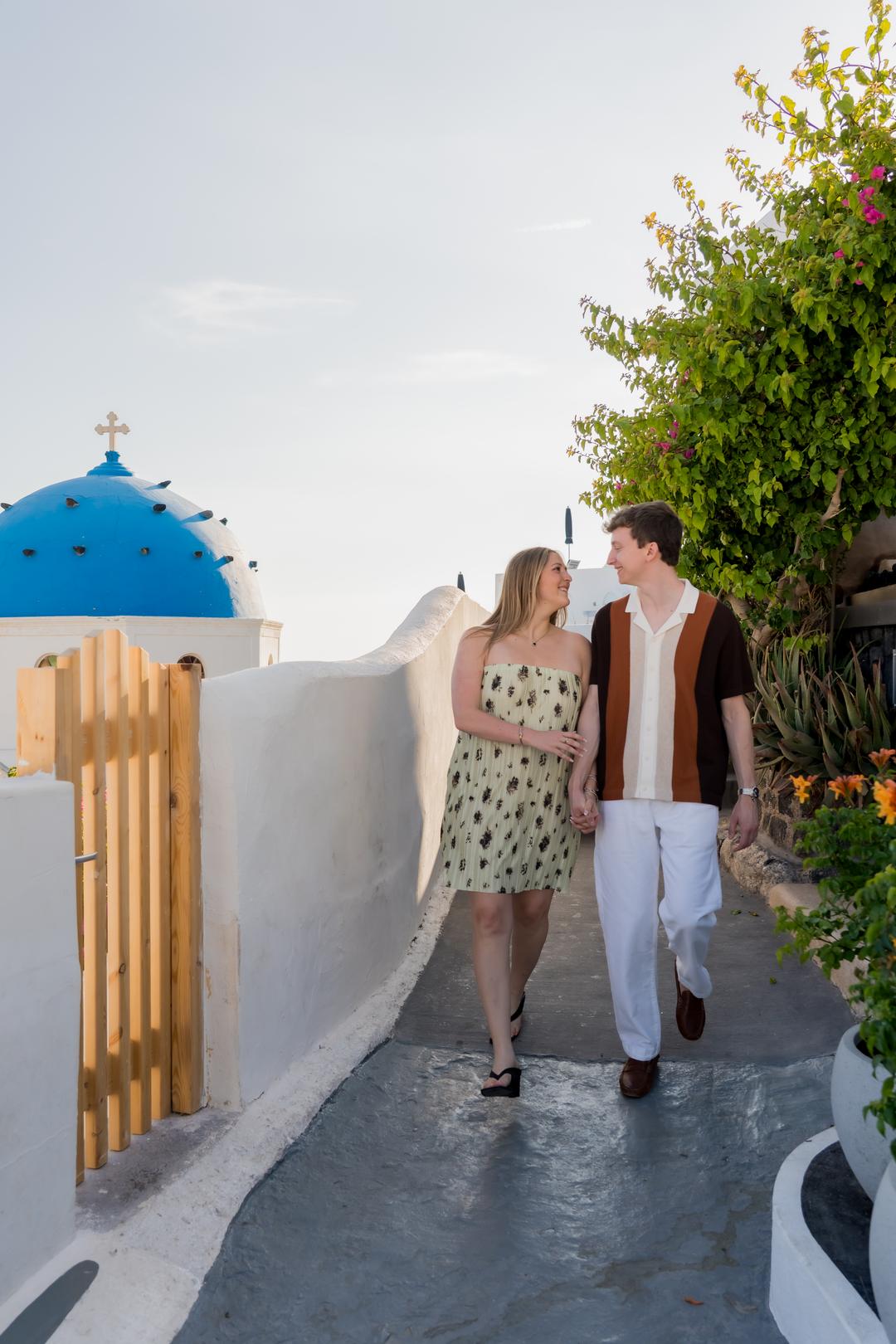
Couples usually arrive at the Orthodox question from one of two directions. Either it matters enormously, because a family has been married in this rite for generations, or it has never been considered and someone has just discovered that a blue dome on a cliff is an actual working church rather than a backdrop. Both deserve a straight answer, and the straight answer starts with a condition rather than a price.
What does an Orthodox ceremony require that a civil one does not?
The common misreading is that the Orthodox route replaces the civil paperwork with church paperwork. It does not. It adds a second layer on top of the first, and both layers have to clear.
The church layer
- A baptismal certificate for the Orthodox partner
- Evidence of baptism for the other partner, in another Christian denomination
- The parish's own permission for the date and the priest
The civil layer, unchanged and underneath
- Passports, long-form birth certificates, certificates of no impediment
- Apostilles on every foreign government document, and certified translation into Greek
- Municipal review, running eight to twelve weeks end to end
Both layers, in that order. The church cannot stand on nothing.
The precondition sits above both layers and outranks them: at least one of you must be a baptized member of the Orthodox church. No planner can arrange around that, and any site implying otherwise is selling you a conversation you will lose later. If neither of you meets it, the civil route is a full legal marriage with a shorter file, and a symbolic ceremony will hold every other thing you wanted about the day.
Who this route is genuinely for
It is for couples where the rite itself is the point, usually because one family has always married this way and the continuity matters more than the convenience. Those couples tend to know already, and the planning conversation is about parish, priest and date rather than about whether. It is also, occasionally, for couples who discover the tradition through one partner and choose it deliberately, which works well when the discovery happens early enough for the paperwork to follow.
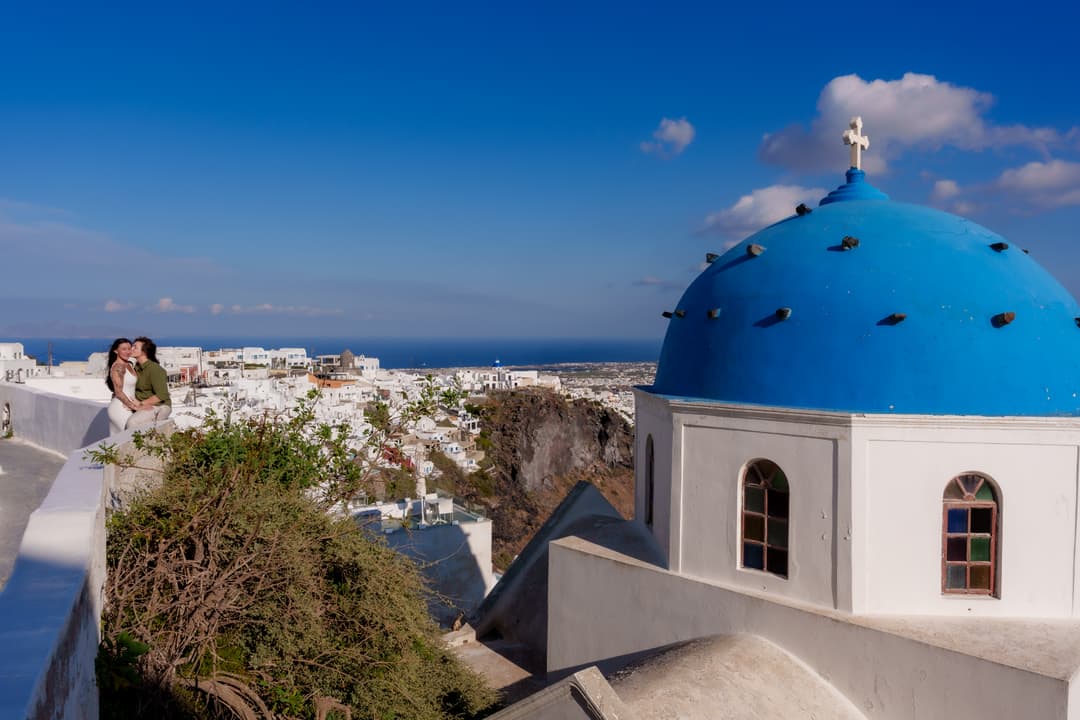
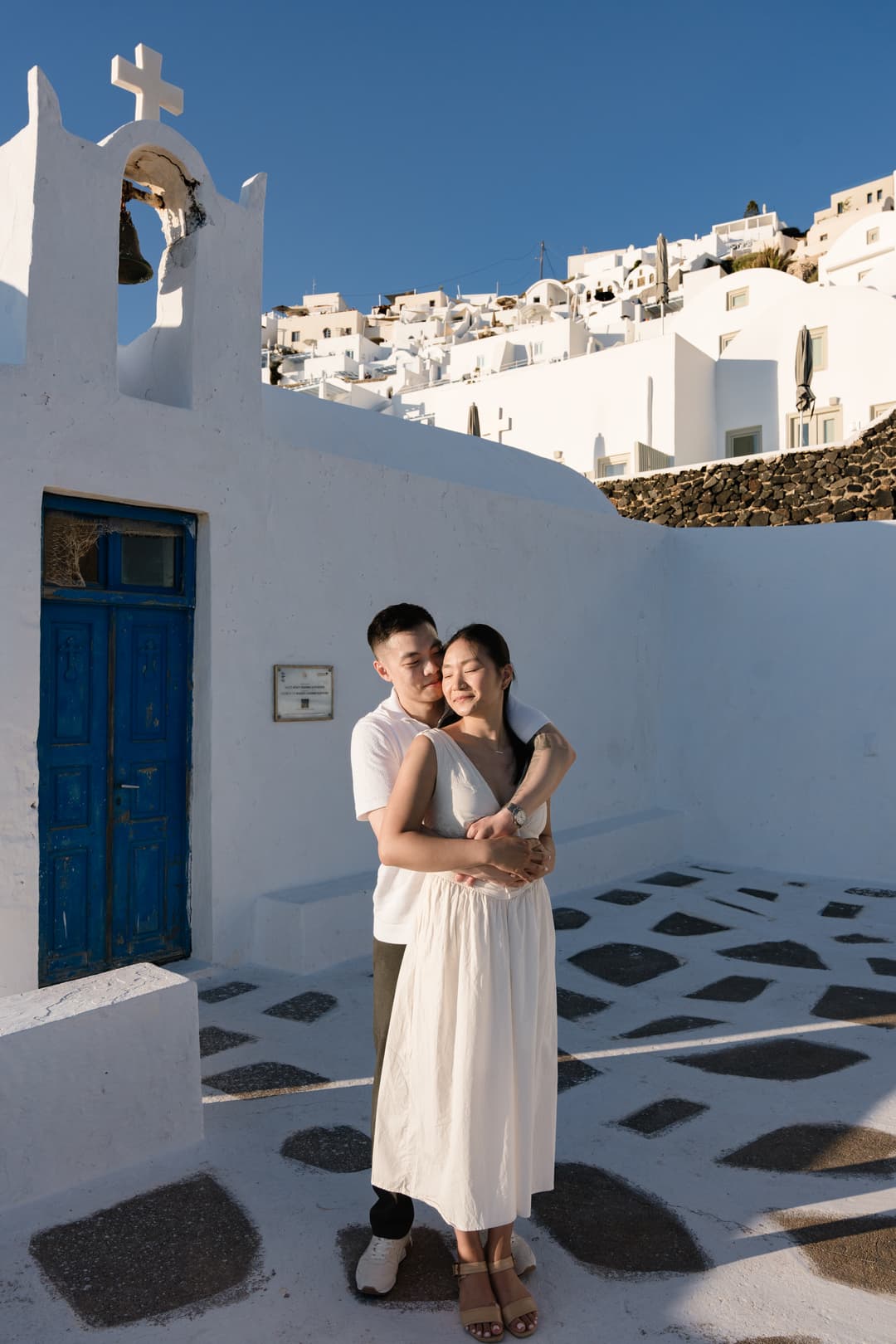
It is a poor fit for anyone drawn purely to how a domed chapel photographs. That is a real and reasonable want, and it is better served by holding a ceremony on a terrace with the domes in frame than by attempting a rite whose conditions you do not meet. We will say so plainly rather than let you find out from a parish office.
Request your document checklist
We publish no requirements list, because the Orthodox set varies by parish as well as by nationality and a static list would mislead somebody on the day they read it. Send us both nationalities, the baptismal position of each of you, and the date you are considering. We will come back with what the two authorities would actually ask for in your case.
The Orthodox route, asked and answered
Does one of us really have to be Orthodox?
At least one partner must be a baptized member of the Orthodox church, and that requirement is not negotiable by a planner, a venue or a fee. The other partner must ordinarily be a baptized Christian of another denomination. Couples who meet neither condition are looking at a civil or symbolic ceremony instead, and there is no version of the Orthodox rite that works around it.
Is the Orthodox ceremony legal, or do we also need a civil one?
An Orthodox ceremony performed in Greece is a legal marriage in its own right, so no second civil ceremony is needed. The paperwork burden is what grows: the church asks for baptismal certificates and its own permissions in addition to the civil document set, which means two authorities reviewing two files rather than one.
How much longer does the Orthodox route take?
Plan on the civil timeline plus the church's own review, which runs in parallel only if both files are started together. The civil side alone takes eight to twelve weeks before a license is issued. Starting the church conversation in the same week you start gathering certificates is the single decision that keeps the two clocks from running end to end.
Which church will we marry in?
That is settled during planning rather than advertised on a page, because availability depends on the parish, the priest and the date, and no honest site can promise a specific church before those three are checked. The caldera villages hold several, and the practical constraint is usually access and guest numbers rather than the building itself.
Does the package price change for an Orthodox ceremony?
No. The ceremony type is a configuration inside a package and the three wedding floors do not move with that choice. What is quoted separately is the document handling, because an Orthodox file carries the church's requirements on top of the civil ones and the work scales with both nationalities.
Tell us the date. We will hold the light.
One conversation is enough to know whether we are the right house for your proposal. No pressure, no scripts — just an honest read on your dates.
Prefer to write first? WhatsApp us at +30 694 4803339 — a planner replies, not a bot.