Santorini sunset times, month by month
DEC 17:05 · JUN 20:40 · 36.42°N 25.43°E
June holds its light until 21:15. That is enough time to say one sentence slowly.
Santorini's sunset moves from about 17:05 in December to 20:40 at midsummer. Golden hour begins roughly an hour earlier, and our arrive-by guidance runs 15 to 25 minutes before that. The full month-by-month table below lists sunset, golden hour, arrival time, and afterglow for 36.42 N, 25.43 E.
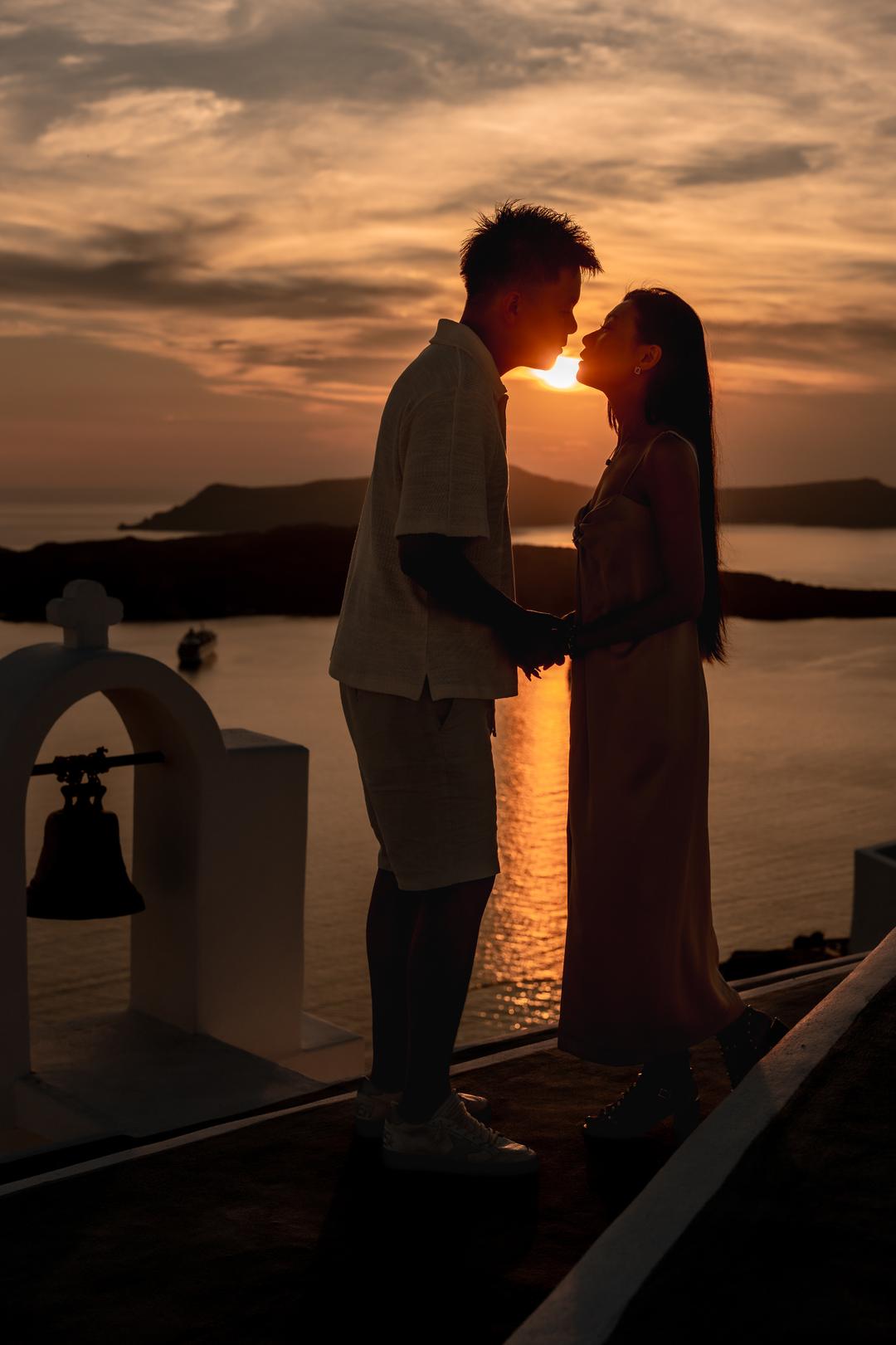
Sunset on Santorini is a schedule, and schedules can be printed. The table below is the one we plan every proposal against: monthly average sunset for the island's coordinates, when the light turns genuinely golden, when to be standing at your mark, and how long the sky holds color after the drop. Everything else on this page teaches you to read it like a planner rather than a tourist.
What time is sunset in Santorini each month?
| Month | Sunset | Golden hour from | Arrive by | Afterglow until | The sun drops |
|---|---|---|---|---|---|
| January | 17:35 | 16:45 | 16:30 | 18:05 | into open sea southwest of Thirasia |
| February | 18:05 | 17:15 | 17:00 | 18:35 | into open sea, west-southwest |
| March | 18:30 | 17:40 | 17:25 | 19:00 | just south of Thirasia |
| April | 19:55 | 19:00 | 18:45 | 20:25 | beside Thirasia, edging north |
| May | 20:20 | 19:25 | 19:05 | 20:50 | behind Thirasia's north shoulder |
| June | 20:40 | 19:45 | 19:25 | 21:15 | northernmost — open water off Oia |
| July | 20:40 | 19:45 | 19:20 | 21:10 | north of Thirasia, drifting south |
| August | 20:15 | 19:20 | 18:55 | 20:45 | behind Thirasia from the central rim |
| September | 19:30 | 18:35 | 18:15 | 20:00 | beside Thirasia, moving south |
| October | 18:45 | 17:55 | 17:40 | 19:15 | south of Thirasia, open water |
| November | 17:20 | 16:30 | 16:15 | 17:50 | into the open southwest sea |
| December | 17:05 | 16:15 | 16:00 | 17:35 | southernmost point, open water |
Fig. 1. The workable window of light month by month, from golden hour to the end of afterglow, as monthly averages: December runs 16:15 to 17:35, June runs 19:45 to 21:15. The marked point on each row is that month's sunset.
Fig. 2. The year of sunsets at Santorini, drawn from twelve monthly averages: from December at 17:05 to June at 20:40, with June holding its afterglow until 21:15.
Two clock caveats worth respecting: Greece changes clocks on the last Sundays of March and October, so late-March sunsets jump to about 19:30 on summer time and late-October evenings fall back toward 17:40. If your trip brackets either Sunday, re-check your specific dates rather than the monthly average.
Reading the table like a planner
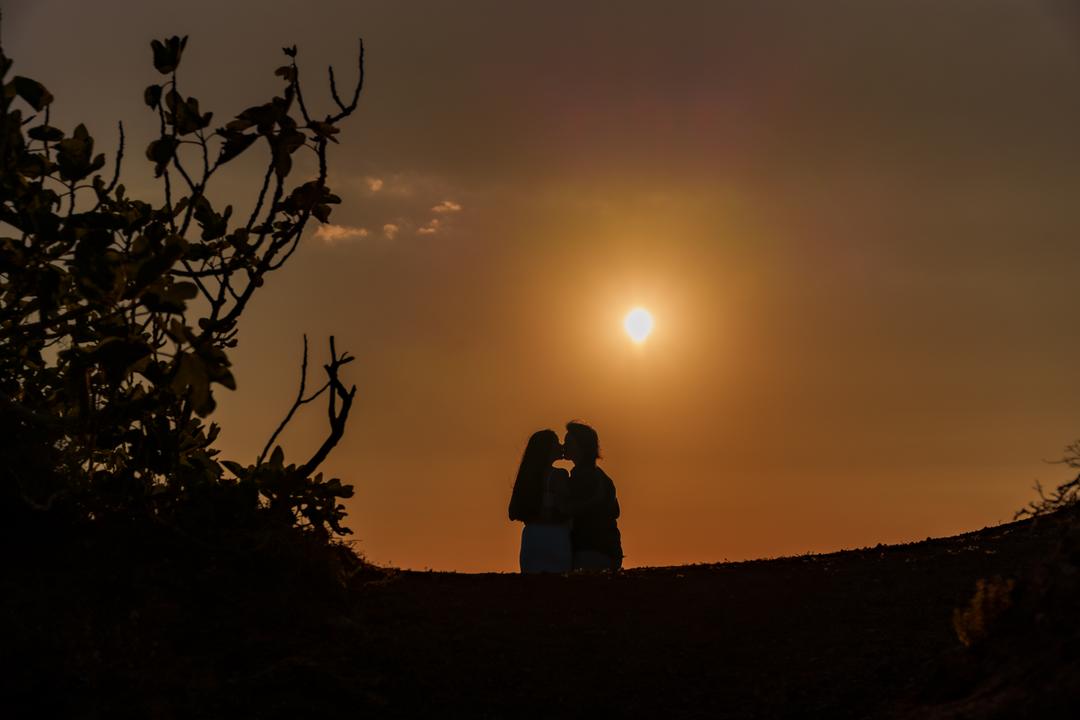
The arrive-by column is guidance for being calmly in position, not a last-safe-minute; at the island's contested rails the discipline tightens further — the hour-by-hour reality at the most famous of them is documented in the Oia guide. The afterglow column is the underused gift: color holds for roughly half an hour after the drop while crowds drain away, a window photographers quietly prefer. And the question itself belongs in golden hour, not at the sunset minute — the timing mistakes this table prevents fill a chapter of the failure catalog.
This page answers the clock; its sibling answers the calendar — months, crowds, and prices live in the best-time guide. Match the hour to the ground with the ranked places guide, and if you want the light handled by someone who watches it professionally, that is what the photographer is for.

Reading the light, precisely
How early before sunset should we actually be in position?
Use the arrive-by column: roughly 65 to 80 minutes before the drop, widest in high summer. That is not superstition — it covers claiming the position you scouted, letting nerves settle, and putting the question in the warm window rather than at the rushed edge of it. At contested spots in season, earlier still; on a private terrace, the column is comfort rather than necessity.
What is the difference between golden hour and the sunset minute?
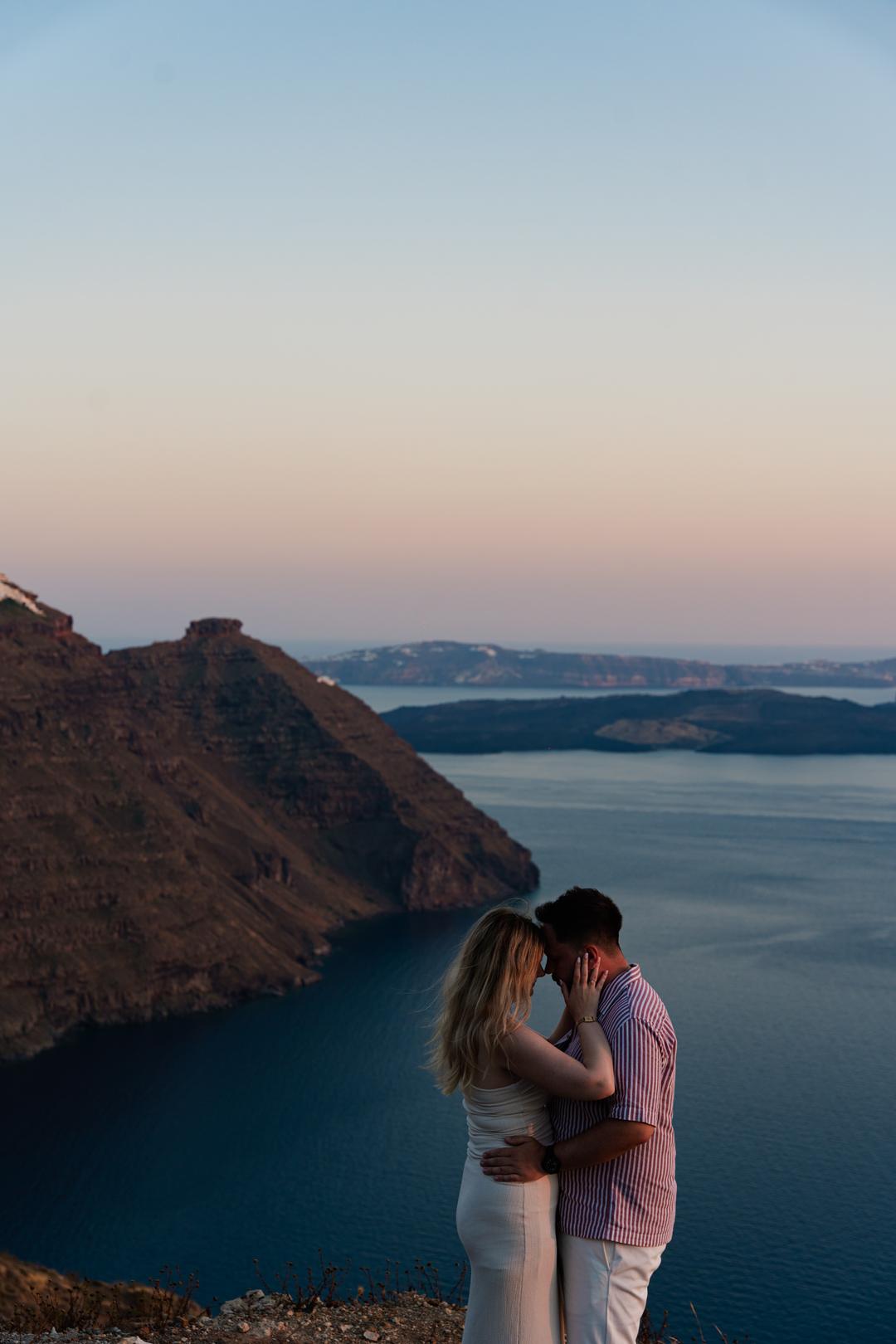
Golden hour is the working window — the final stretch when low sun flatters faces and the ring catches real light. The sunset minute is the finale, dramatic for the sky and mediocre for portraits, since faces fall into shadow against a bright horizon. The photograph you are imagining happens twenty to forty minutes before the sun touches the water.
Does the sun set over water or land from the caldera villages?
It depends on the season's geometry, which the table's last column tracks. Around midsummer the sun sets at its northernmost point — off Oia it clears Thirasia into open water — while in spring and autumn it drops beside or behind Thirasia's silhouette from most rim viewpoints, and in winter it lands far to the southwest over open sea.
Which months most often produce dramatic color versus a clear drop?
Clear, clean drops dominate June through September. The spectacular burning skies tend to come with weather — spring and autumn evenings when broken cloud catches fire after the drop. February can produce the year's most violent color between fronts, and the honest cost of chasing it is that some evenings deliver a grey lid instead.
Tell us the date. We will hold the light.
One conversation is enough to know whether we are the right house for your proposal. No pressure, no scripts — just an honest read on your dates.
Prefer to write first? WhatsApp us at +30 694 4803339 — a planner replies, not a bot.