A proposal built backward from the sunset minute
A Santorini sunset proposal is an evening we build backward from the minute the sun actually sets on your date. We pull that month's published figures, then place setup, arrival, the question and the afterglow around them, so the light is never something the plan merely hopes for. The date decides the ground, not the other way around.
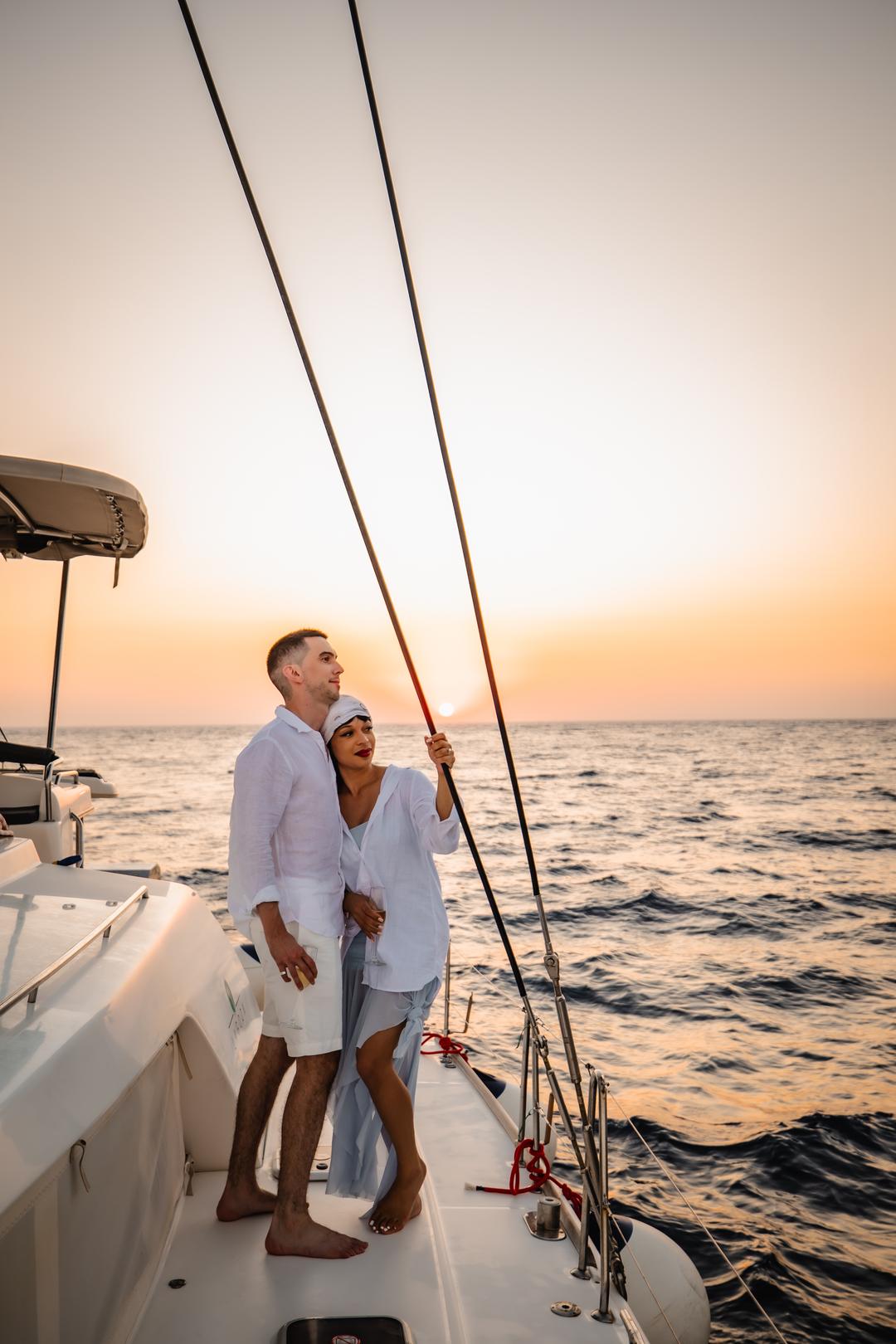
Every couple says sunset. Almost nobody plans from it. The word appears in nine of ten first messages we receive, and then the planning proceeds as if the sunset were scenery that will simply show up — a place gets chosen, a dinner gets booked, and the light is expected to fit in around them. But the sunset is not an atmosphere. It is a minute, published in advance for the island's coordinates, and it falls at a different minute in every month of the year. An evening built backward from that minute behaves differently from an evening pointed at it: nothing rushes, nothing collides with the good light, and the question lands where the light is best rather than wherever the reservation left a gap.
And when the answer to "where" is the water rather than the rim, the evening usually resolves to AION at the Old Port — the sea-level terrace where the sunset happens at eye height and more of these evenings are staged than anywhere else we work.
One division of labor before anything else. The almanac — every month's sunset minute, when the gold begins, when to be standing still, how long color survives the drop — lives on the sunset times page, and it rewards a slow read. This page is the service built on top of it: how we take your date, pull that month's real figures, and engineer the whole evening around them.
Three beats, one minute
Every sunset proposal we run resolves into the same three beats, each defined by its distance from the drop. September — the planners' favorite month, and this page's worked example — shows the arithmetic plainly.
In position
Before the minute. The arrive-by figure runs well ahead of the drop by design: in September, standing at your mark by 18:15 for a 19:30 sunset — a monthly average, honest to five minutes.
This beat decides the other two. You arrive with daylight in hand, the position already yours, the photographer already placed and looking like nobody. The spare minutes are not padding; they are what calm looks like on a schedule. Couples who arrive at the last plausible moment spend the good light recovering from the walk.
The question
At the drop, with the sea still lit. September's low gold arrives around 18:35, which leaves close to an hour of warm, forgiving light before the 19:30 finale — the ask belongs inside that hour, not after it closes.
Asked here, the question gets everything at once: faces lit instead of silhouetted, the ring catching genuine sun, and the horizon performing behind the answer rather than competing with it. There is no racing the light and no glancing at the water mid-sentence. The sun finishes its work while you are still holding each other.
The afterglow
After the drop, while the color holds. In September the sky keeps its ember until about 20:00 — half an hour that most of the island spends walking back to the car.
This is the stretch we refuse to give away. The crowds drain, the wind often eases, and the light goes soft in a way no earlier minute can match. The champagne, the phone call home, the unhurried portraits — all of it lives here, in the part of the evening most couples never knew they had booked.
What is the working window, exactly?
Not one minute — roughly an hour and a half of usable light, running from when the gold reliably begins, through the drop, to when the caldera's color finally fades to blue. In June that window opens at 19:45, peaks at the 20:40 drop, and holds until 21:15. In December the whole sequence compresses — 16:15, 17:05, 17:35 — but keeps its shape. Every figure here is a monthly average for the island's coordinates, rounded to five minutes, and we re-check your specific dates against the clock-change Sundays in March and October. Which month should hold your evening in the first place is a calendar argument, not a clock one, and it is made properly in the best-time guide.
Which coasts face the light, and when
The sun does not drop in the same place twice. Through the year it travels the horizon: at its June northernmost it passes beyond Thirasia, giving Oia a drop into open water; through July it drifts back south of that mark; by August it is setting behind Thirasia when seen from the central rim. Spring runs the film in reverse — beside Thirasia and edging north in April, behind the island's northern shoulder by May — while September and October carry it south again until the winter months put it far out over the open southwest sea.
This geometry is why we will not pick your ground before your date. A couple set on watching the sun meet clear water belongs in midsummer at the island's northern tip — the full case for and against that famous village is argued in the Oia guide — or almost anywhere west-facing in winter. A couple who wants Thirasia's dark profile burning in the frame is better served by the shoulder months from the central rim. Same island, different sunsets, and the date decides which one you get.
The timeline, built backward
Here is the house method, stripped of mystique. We open that month's figures and work in reverse. The afterglow is reserved first — it is the most valuable half hour and the first thing a loose plan sacrifices. The question is slotted while the sun still stands above the water. Arrival is pinned to the arrive-by minute, and in July we pull it earlier still, because in peak season holding a position takes longer than the light alone requires. Setup — the florist, the candles, the photographer's cover — completes before you are within sight of the place. Dinner is booked last and, in June's late-drop months, always after: when the sun goes down at 20:40, the table waits for the answer, not the other way around.
If that reverse-order discipline sounds familiar, it should — it is the same arrival-minute thinking that governs every evening we run, laid out stage by stage on the how-it-works page. The person executing it around the light is the photographer, who watches these windows for a living and is in position before either of you. And the method costs nothing extra: every tier on the packages page is scheduled exactly this way, from the €950 floor through €1,750 to the €4,900 tier. What changes between them is what surrounds the minute, never how seriously the minute is taken.
So start from the light. Tell us the month you are thinking of, and the first reply will contain that month's real numbers and what they make possible. The sunset is the one collaborator on this island that publishes its schedule; the rest of us just have to read it.
What sunset-first couples ask next
When does each part of the evening get its slot?
In reverse. The month's sunset minute is fixed first, straight from the published average. The afterglow window is reserved next, because it is the easiest thing to lose. The question is placed while the sun is still above the water, arrival lands at that month's arrive-by figure, and setup — flowers, candles, the photographer's position — is finished before you are anywhere near the site. Dinner takes whatever the light leaves over, which in summer means afterward.
What is the plan when clouds band the horizon at 6 p.m.?
A banded horizon is a judgment call, not a cancellation, and the planner on the ground makes it in daylight. Low cloud on the water usually mutes the drop itself and then sets the afterglow alight, so the evening often shifts a few minutes later rather than anywhere else. High cloud over clean air argues the opposite: ask earlier, inside the dependable gold. Only a full grey lid triggers the sheltered alternative, and that call is made hours out.
Is proposing in the afterglow a real option?
A quietly excellent one. Once the sun is down, the famous viewpoints empty within minutes, the light turns ember-soft with nothing left to squint against, and the sky frequently does its best work then. The window is real but brief — color holds to about 21:15 in June and 17:35 in December — so an afterglow ask is choreographed more tightly than a pre-drop one. It does not forgive a late arrival.
How does the light move around the island through the year?
The sun walks the horizon. At midsummer it stands at its northernmost, passing Thirasia entirely so that from Oia the drop lands in clear water. Through spring and autumn it sits beside or behind Thirasia's silhouette from most of the rim, and by December it has reached its southernmost point over the open southwest sea. The same terrace therefore watches a different sunset in May than in October — which is exactly why we choose the ground after the date, never before.
Does a sunset proposal require the famous rails?
No. The sunset is island-wide; the rails are only one place to stand in it. A private terrace, a ridge path, a boat deck at anchor all receive the identical minute, most of them with far less company. The famous rails buy a recognizable backdrop at the price of a crowd arriving on the same schedule you are. When the light itself is the point, the ground becomes a free choice — and the quiet grounds usually photograph better.
Tell us the date. We will hold the light.
One conversation is enough to know whether we are the right house for your proposal. No pressure, no scripts — just an honest read on your dates.
Prefer to write first? WhatsApp us at +30 694 4803339 — a planner replies, not a bot.