An Oia proposal, planned against the clock
SUNSET 5/5 · PRIVACY 2/5 · WIND EXPOSURE 3/5
Oia scores 2 of 5 for privacy at golden hour, and we will still get you a minute that belongs to nobody else.
Oia rewards precision more than any proposal spot on Santorini. Its castle terraces fill from ninety minutes before sunset in season, yet the village at 6 a.m. belongs to whoever wakes for it. Propose here with a micro-spot plan and an exact arrival minute, or choose dawn and have the postcard to yourselves.
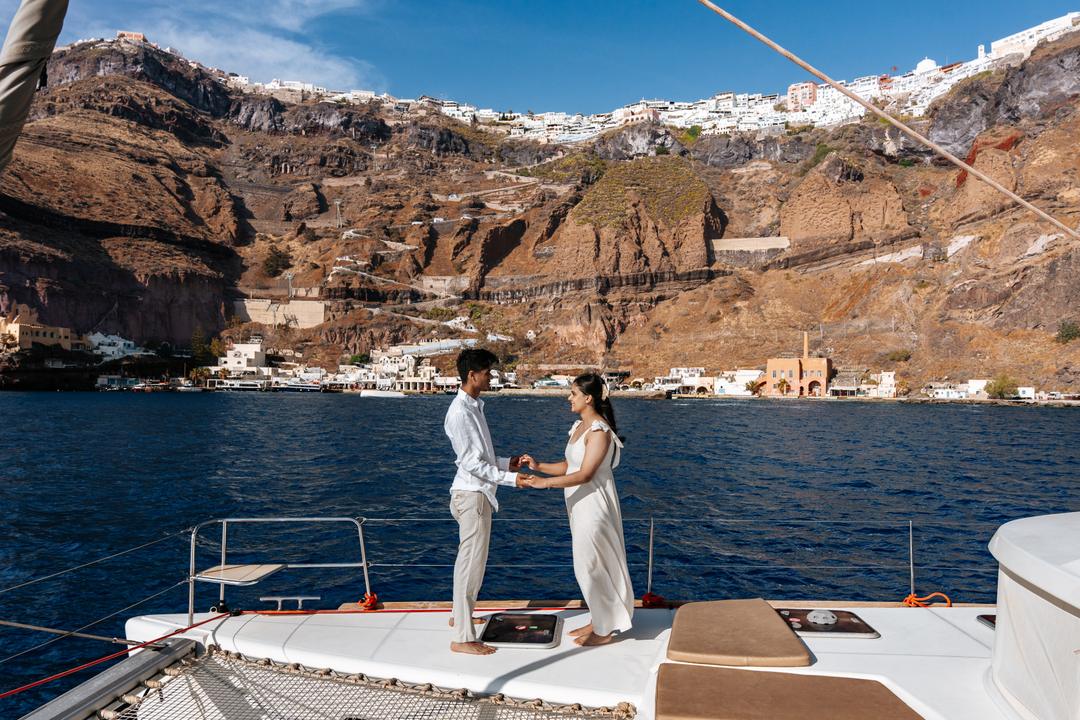
Here is the number that should organize your whole evening: in high season, the difference between arriving at the castle two hours before sunset and one hour before is the difference between choosing your rail and taking what is left. Oia is not overrated — the light is real, the geometry is real — but it is a venue with a schedule, and the schedule is not yours. Plan with the curve below and the village cooperates beautifully.
The sunset crowd curve, hour by hour
| Time before sunset | The castle terraces | Your options | Compare |
|---|---|---|---|
| 3 h | Open; photographers staking tripods | Every micro-spot still available | |
| 2 h | Filling steadily | Best positions claimable with patience | |
| 90 min | Dense; rail space contested | Shift to the windmill side or a quiet rail | |
| 60 min | Effectively full, standing room | Proposal here now means an audience | |
| At the drop | Peak crush, applause at the sun | Beautiful to witness, brutal to work in | |
| +20 min | Emptying fast | The afterglow window — quietly excellent |
That last row is a genuine secret: civil twilight, when the crowd has drained and the sky over Thirasia still holds color for another half hour — the sunset table lists the afterglow window for every month. Some of our favorite Oia proposals have happened at 20:55 in June, alone at a rail that held four hundred people forty minutes earlier.
A plan held for every ground
Oia is one name for four grounds, and the house keeps a working plan for each of them rather than a favorite. A plan names where you stand, where the photographer stands, which way a setup faces, and what the evening does if wind or crowd rules that ground out before you arrive.
Which one we use is a scheduling decision, and we make it. The sunset hour goes to the windmill row, because the castle terraces are contested at exactly that hour. The castle earns the edges of the day instead — first light, or the afterglow once the terraces empty. When the meltemi is up, the plan moves off the rim entirely. You are not handed a menu; you tell us the hour you want and how much company you can tolerate, and the ground arrives attached to your date.
Choosing costs something in service terms, and the cost is ours to carry. A ground down a stair changes where we collect you. An exposed ground changes what can be built on it and how late the wind call can wait. A ground the crowd takes after a certain minute changes your arrival time and nothing else about your evening. If you want the grounds themselves — footing, shelter, the frame each one gives a camera — the Oia micro-spots dossier takes them in turn. This page keeps the clock; that one keeps the terrain.
Two scores, and the trade between them
Our planners score every place in the register from one to five. Two of those scores decide Oia: the sunset sightline itself, and privacy at golden hour in high season. Here the two readings pull hard in opposite directions, and that pull is the whole Oia decision. So we print both, and what the rest of the register charges for the same light.
5of 5
Sunset sightline
The highest score we award, and not Oia’s alone: eight of the fifteen entries in our register hold it.
2of 5
Privacy at golden hour
One entry in the register scores lower, and it is also in Oia: the Three Blue Domes viewpoint, at 1 of 5.
- When the charge is collected
- Not all evening, and not across the whole village. The castle terraces fill well before the last of the light, which is the part you came for. The crowd’s deadline lands first.
- What the privacy score misses
- It is one number for a whole village at its most public hour. Oia’s own entry names four grounds inside the village, as many as any entry in the register names anywhere, and the section above tells you which of them we use and when. What we will not do is hand you a second number we never measured.
- The same light, elsewhere
- Seven other entries in the register also score 5 for the sunset. Six of them score higher than Oia for privacy and one ties it. Two are private ground — a booked terrace, a hired villa — and they hold that same 5 at privacy 5, the highest reading we give. So the light is not the thing Oia is charging you for.
The balanceTwo windows where that second score stops applying: the empty hour after first light, and the one that opens as the terraces clear once the sun is gone. Neither buys you the sun falling into the sea — the first comes before it, the second after — and both are printed in Oia’s own entry. Between them they are why this page argues for a different hour rather than a different village.

The 6 a.m. version
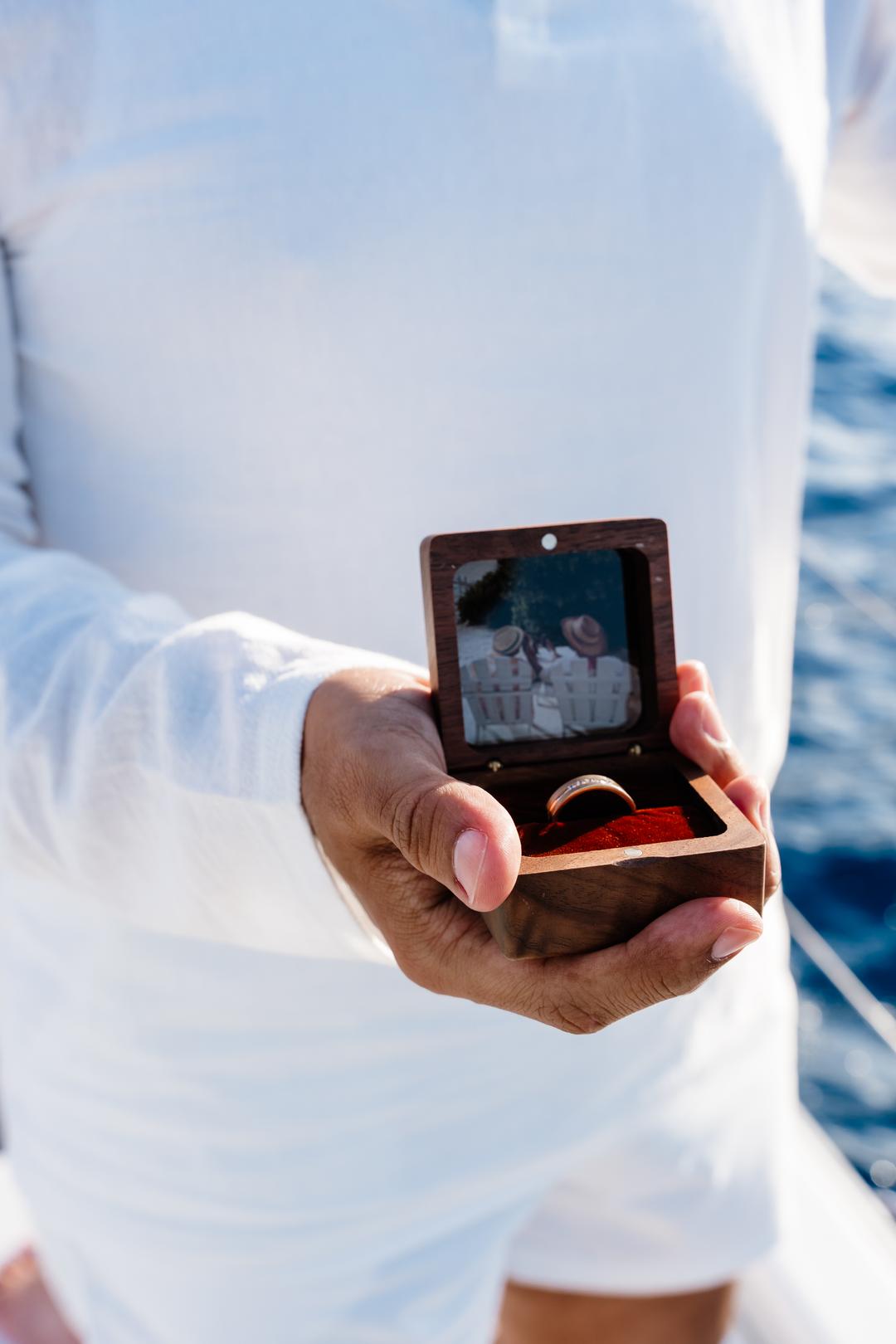
Dawn inverts every Oia problem. The lanes are empty, the marble is gold instead of hot, and the three domes photograph without a single stranger in frame. The plan is simple: in position by first light, the question while the sky is still pink, forty minutes of portraits through the empty village, then the first table at a harborside breakfast as the day begins. If your dates fall in July or August, when the evening curve is at its most merciless, dawn is not the fallback — it is the professional recommendation, and the anti-crowd guide extends the same logic across the island.
Oia, measured
- Getting there
- Castle viewpoint is 10–12 min on foot from the bus square, all pedestrian marble lanes
- Crowd pattern
- Filling from 90 min out in season; near-empty again 20 min after the drop
- Wind exposure
- Privacy at golden hour
- Sunset sightline
- Best light
- Final 40 min before sunset; 06:00–07:30 for empty-lane softness
- Footwear truth
- Marble polishes slick — leather soles skate, especially on stair lanes
- Plan B
- Firostefani's rails, or a reserved terrace; for wind, drop below the rim toward Ammoudi
The marked months pair Oia's light with a survivable crowd curve; July and August work best at dawn or afterglow.
Making the photographer disappear
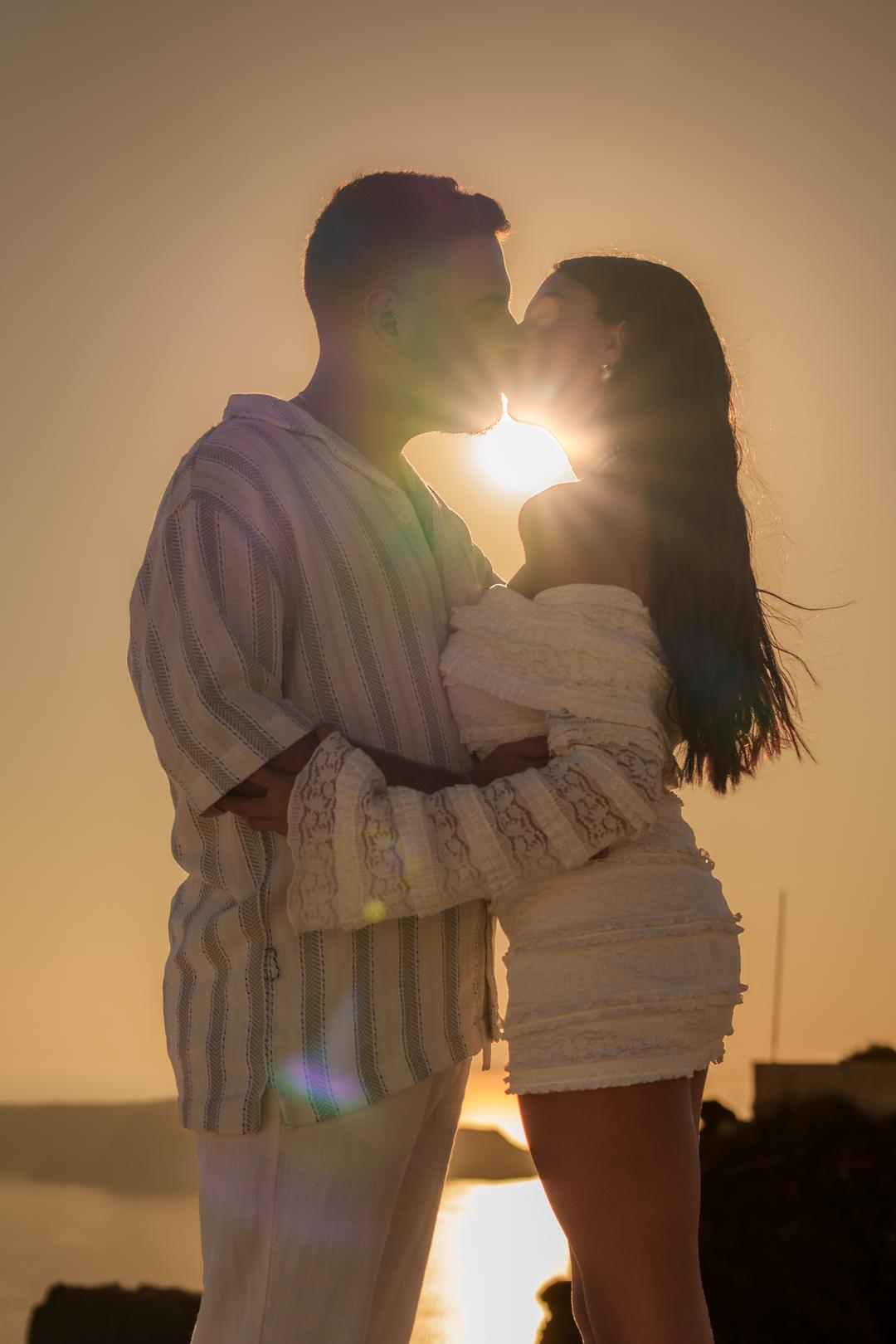
In Oia the camouflage is the crowd itself. Our photographers hold pre-scouted positions — a stair landing above the windmill path, a rail thirty meters along the curve — where one more person photographing the view means nothing. You get a description of their shirt, never an introduction; the cue that starts coverage is your pause at the agreed mark. From there, the working rule is thirty uninterrupted minutes: the question, the shaking hands, the phone calls half-dialed and abandoned. The mechanics of all of it live on the secret photographer page.
If Oia's arithmetic ultimately argues you out of proposing here — it does for many couples, and there is no shame in it — the honest alternatives are one ridge away: Firostefani for the same geometry with room to breathe, Ammoudi Bay below the cliff for sea-level gold, or the blue domes at dawn for the postcard without the queue. Whichever way it lands, a package carries the timing so you only carry the ring, and the full field of alternatives waits on the location index.
Oia, asked and answered
When exactly do the castle crowds peak?
In season the castle terraces are effectively full from about an hour before sunset and stay packed until roughly twenty minutes after the drop, when they empty almost at once. The practical takeaway: claim a position two hours out, or plan the question for a quieter micro-spot and visit the castle afterward for the view alone.
Is a dawn proposal in Oia genuinely better, or a consolation prize?
Better, by most measures a photographer cares about: soft directional light, empty marble lanes, and the domes to yourselves for an hour. What dawn lacks is the fireball into the sea. Couples who want Oia itself — the architecture, the stillness, the famous geometry — usually thank us for the early alarm.
Should we choose the castle or the windmills?
For the question itself we usually stage at the windmill side or a quiet rail, then walk the castle view afterward as newly engaged people. That is a scheduling answer more than a scenery one: the castle terraces are contested at exactly the hour you want them, and the windmill row is not. The ground-by-ground reading — footing, shelter, and the frame each one gives a camera — is set out on the micro-spots dossier rather than here.
Can a photographer really work unseen in a village this busy?
Oia is, counterintuitively, one of the easier villages to hide in: a person with a camera photographing a view is invisible here because hundreds of people are doing exactly that. Position, not camouflage, does the work — pre-scouted angles thirty meters off, agreed hand cues, and no eye contact until the yes.
Tell us the date. We will hold the light.
One conversation is enough to know whether we are the right house for your proposal. No pressure, no scripts — just an honest read on your dates.
Prefer to write first? WhatsApp us at +30 694 4803339 — a planner replies, not a bot.