The questions Reddit keeps asking, answered with numbers
This page answers the Santorini proposal questions Reddit keeps asking — crowds, cost, authenticity — with the numbers the threads never include. The castle fills from an hour out and clears twenty minutes after the drop, every ground carries a wind score from one to five, and package floors are printed from €950.
Somewhere between choosing the ring and booking the flights, nearly everyone ends up in the same posture: one in the morning, screen glowing, reading strangers argue about the exact evening you are trying to build. There is no shame in it. The questions in those threads are real and unusually good — is the castle a crush, is the whole island a markup, will an arranged moment feel like theater — because underneath the phrasing they are all one question wearing different clothes: what if I get the unrepeatable part wrong.
What the threads lack is not sincerity; it is dates and figures. The typical answer was written two summers ago, from a single trip, at the most congested hour, and it circulates today with its confidence intact and its context gone. Prices drift, rules move, and a word like crowded carries no information until someone attaches a clock to it. So here are the questions that return season after season, gathered in one place and answered by people who stand on these terraces for a living — with the numbers this site already publishes filled in where the threads leave blanks.
The thread ledger
One disclosure before the ledger. Nothing set in the reader's voice below is anyone's post. Each entry is a recurring question rewritten in our own words — the shape a worry takes by the twentieth time it surfaces on a public forum, composited so that no single writer, account or comment stands behind any line of it. The questions are real because they keep arriving. The wording is ours, and no one is being quoted.
Every sunset photo of the castle looks like a stadium. Is proposing there even realistic, or am I planning the most important minute of my life inside a queue?
Realistic, if you respect the clock the photos never show. In season the castle terraces reach capacity about an hour before sunset, and a spot at the rail is claimed roughly two hours out — nobody should kneel inside that window. The same terraces drain within about twenty minutes of the drop, and at first light the village is close to empty. The threads describe the peak honestly; what they omit is that the peak is narrow and has two quiet sides. The Oia guide maps the whole curve hour by hour.
Half the posts call this island the best decision they ever made, and the other half call it an overpriced theme park. Which half is telling the truth?
Both, because they stood in different hours. The bitter reports nearly always describe one trip: peak weeks, the most photographed viewpoint, the last hour of light, no fallback. The glowing ones describe the deliberate version of the same island. Santorini punishes improvisation and repays scheduling more than any place we know, which is how two opposite verdicts stay simultaneously true. We took the argument seriously enough to give it a page of its own — the skeptic's case, answered charge by charge, including who should honestly choose a different island.
One post swears the whole thing cost a few hundred euros. Another says they spent thousands. I have stopped being able to tell what any of this costs.
Both numbers were probably accurate the year they were typed, which is exactly the trouble with undated advice. The current market runs roughly €300 at the barest end to €10,000 and beyond at the top, and most couples land between €550 and €4,500 depending on ground, decoration, and coverage. Our own packages start from €950, €1,750, and €4,900 — printed publicly, so the figure you budget against is the figure you pay. The full cost guide itemizes what moves a proposal up or down that band, euro by euro.
Do we actually need a planner for this, or is that just something planners tell people like us?
Fair suspicion, so here is the honest split. If your vision is a quiet rail, an early hour, and a ring in a pocket, you do not need us — the timing knowledge that matters is published free across this site. A planner starts earning the fee when the plan acquires failure modes: a decorated setup that must survive wind, a photographer who must stay invisible, a venue that must say yes in writing, a schedule with no second take. Count the ways your evening could break; that tally, not your budget, is the real answer.
Every time someone asks for the actual quiet spots, the answers turn vague. Is everyone gatekeeping, or do these places simply not exist?
They exist, and the vagueness is partly deliberate — on that count the suspicion is right. A genuinely quiet place survives exactly as long as its coordinates stay unpublished; one pinned map, and the terrace you wanted to yourselves develops a schedule of visitors. So we publish zones, not pins: which stretches of the rim, which inland villages, which hours of the day. The exact mark is shared privately once a date and a plan are real, matched to the wind that week. The zone map lays out the policy and everything short of the pin itself.
What does the crowd curve actually look like?
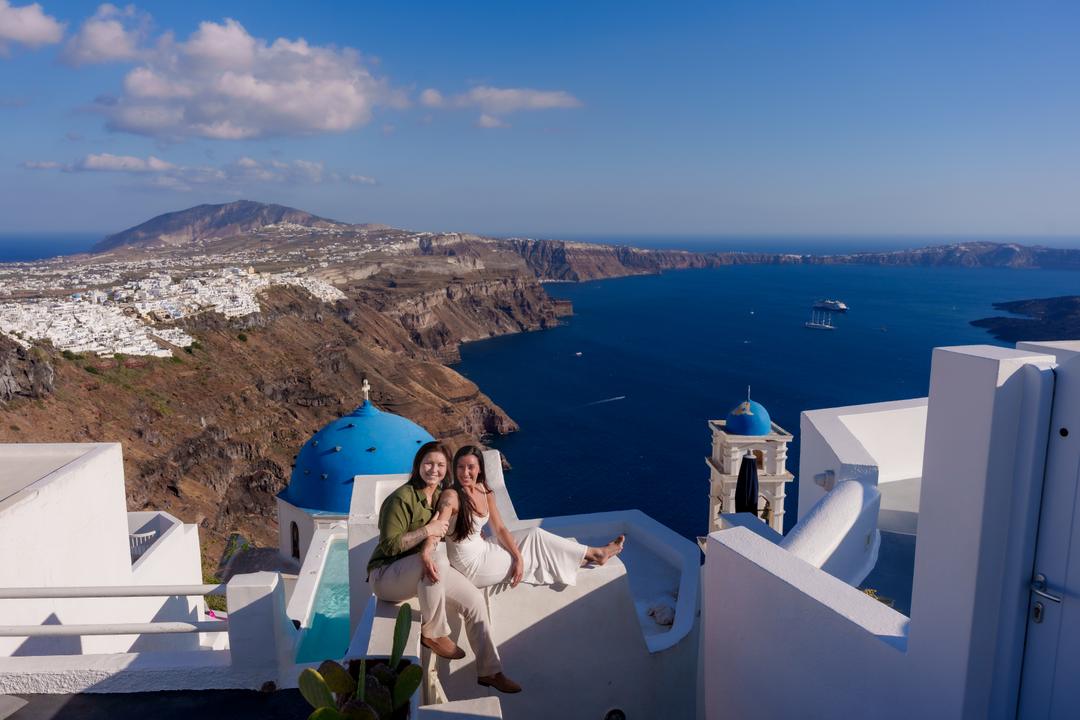
Take the castle as the stress test, because every thread eventually does. In season the pattern is consistent enough to set a watch by. Around two hours before sunset the rail positions go. From roughly an hour out, the terraces behave as full — late arrivals stack into the lanes and stairways, and the open geometry that photographed so calmly at lunchtime is gone. Then the sun touches the water, the phones come down, and inside about twenty minutes the platforms drain as if a tide had turned. The crowd is not a wall; it is a pulse, and the pulse is narrow.
That shape hands you two free strategies. The first is the far side of the drop: hold your ground through the exodus, and the terrace that carried an audience carries a conversation. The second is dawn, the option the threads mention least and the one we rate highest — at six in the morning the lanes are rinsed in early light, the domes stand unattended, and the village belongs to whoever was willing to set an alarm. Neither strategy costs a euro. Both cost discipline, which is precisely why they work. The couples who come to grief here are rarely unlucky; they walked into the final hour with one imagined spot and no alternative, a pattern familiar enough to open the failure catalog.
And the curve describes only the famous corners. Most of the rim never develops one at all — a truth the threads keep circling without landing on, and the reason location strategy matters more than location fame.
Is the wind real, or just thread folklore?
Read a hundred threads and you will meet crowds, prices, restaurants, and rings — and almost never the wind. Yet wind is the datum that actually decides an evening here. It settles whether candles stay lit, whether a dress cooperates, whether words carry or scatter, whether a clifftop feels intimate or embattled. Couples arrive braced for rain because rain is the weather their home cities taught them; on this island the sky is usually generous and the air is the thing with opinions.
So the answer to the thread question is yes, and the practice behind the yes is dull on purpose: every ground we work carries an exposure score from one to five, fixed in daylight, and no date is worth enough to move one. Two ends of that scale make the point. A private dinner terrace is the island's one — the calmest setting we offer, and the only kind where loose petals and open flame are a safe assumption. The Akrotiri Lighthouse is the five — the most cinematic ground here and the most exposed, a trade to make knowingly or not at all. Everything the forums argue about lives between those two, and where each village, deck and cape falls is published rather than negotiated on the day.
What a score buys is a plan that matches its ground. Low on the scale a design can afford to be delicate. High on it the setting is the decoration, and the plan says so out loud, with a sheltered alternate named before the day instead of hunted during it. The scores themselves sit beside every major location in the ranked guide; what happens when the wind actually takes a spot at five in the afternoon opens the day-of failure guide. Between them is the whole answer no thread ever assembles: the wind is real, and it is not a lottery.
How to date-check what you read
None of this argues against the forums. It argues for reading them the way you would read any archive — with one eye on the date stamp. Sort by newest before you sort by best; the most-upvoted answer in an old thread is often the oldest thing in it. Treat any price that travels without a year as history rather than quotation. Notice whether a writer speaks from one trip or from a pattern: testimony from a single August evening at one famous rail is perfectly honest and nearly useless for your own April plan.
Then cross-examine. When a thread and a published page disagree, weight the source that signs its name and can be held to what it prints — a company that states its floors in public has nowhere to retreat when you arrive with the page open. That accountability is the quiet reason our figures live on their own pages with revision dates attached, and it is a better filter than any comment score.
The threads will still be there at one in the morning, and reading them is not a weakness — it is evidence of how seriously you are taking this. But somewhere around the eleventh tab, the useful question stops being what strangers once experienced and becomes what the two of you intend. That part never had a thread. It has a date, a ground, an hour on the right side of the curve — and every number it needs is already in print.
The comment section, cross-examined
What do the threads get right about the crowds?
The consensus holds: the famous terraces in high season are genuinely jammed at the golden hour, and nobody should stage an intimate question in the middle of that. What almost no answer supplies is the number that changes the verdict — the congestion is roughly an hour wide. It builds through the final sixty minutes before sunset and lets go about twenty minutes after the sun lands, leaving the same stone quiet. Once that width is known, the crowd stops being a reason to avoid a place and becomes a reason to time it.
How much of what older threads say about prices and rules still applies?
Less than the confident tone suggests, because a thread never expires and a price always does. Venue terms, permit rules, and vendor rates on this island shift season to season, while an answer typed years ago circulates alongside one typed last week, indistinguishable in authority. Most sticker shock we meet — and most false bargains — trace back to figures that were briefly true and never updated. The correction is simple: check the date before the upvotes, treat any undated number as history, and anchor your budget to sources that print current figures in public.
Is hiring someone to plan a proposal cringe, the way some threads claim?
The worry deserves a straight answer: no, and the fear usually points at the wrong target. What makes a moment feel staged is an audience, a rushed window, or a partner squinting into a crowd — precisely the things planning removes. The words, the look on both faces, the shake in a voice: none of that can be arranged, and it is all anyone remembers. If elaborate staging is not who you are, then do not buy staging — an empty rail at first light and a ring carried quietly is also a plan. Planned does not mean performed; it means protected.
Which Reddit warnings should we actually take seriously?
Three have earned their reputations. Wind warnings are real: an exposed setup without a sheltered fallback fails often enough that we score every ground for it. Peak-hour warnings are real: timing does more work on this island than money does, and no budget buys back a spot inside the crush. And the warnings about posting scouting photos are real: a tagged story has ended more surprises here than weather ever has. Discount the sweeping verdicts — everything is ruined, nowhere is quiet — which almost always compress one difficult afternoon at one famous spot into a judgment on an entire island.
Why do locals and planners answer differently from tourists?
Sample size, mostly. A visitor speaks from one trip — often taken in the busiest fortnight, standing at the most famous spots at the most photographed hour — and describes it honestly. People who work these terraces answer from years of evenings spread across the whole calendar, so they know when the famous places empty, which villages the crowd never reaches, and what the wind is doing behind the postcard. Neither voice is dishonest. One holds a single data point collected under worst-case conditions; the other holds the curve. When the two disagree, the disagreement is usually about the hour, not the island.
Tell us the date. We will hold the light.
One conversation is enough to know whether we are the right house for your proposal. No pressure, no scripts — just an honest read on your dates.
Prefer to write first? WhatsApp us at +30 694 4803339 — a planner replies, not a bot.