When a Santorini proposal goes wrong on the day itself
A Santorini proposal gone wrong is almost always day-of mechanics — wind, crowds, custody, a no-show — and each failure has an engineering answer. This guide covers what breaks between breakfast and the question — the five o'clock wind call, the surge day, the ring in the wrong pocket — and the protocol that absorbs each.
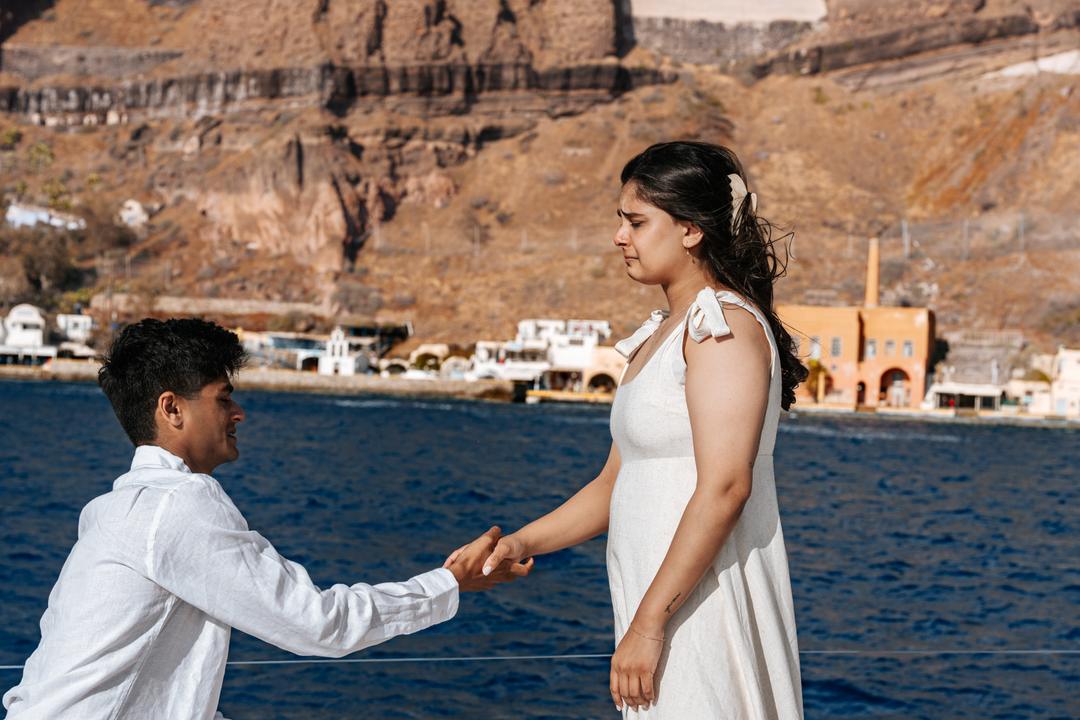
Proposals almost never fail at the idea. The idea — the island, the terrace, the question — survives contact with reality remarkably well. What fails is five o'clock on the day itself: a wind that was not in the morning forecast, a ship that emptied into the one lane you needed, a ring sitting in the wrong jacket at the wrong minute. These are mechanical failures, small and specific and stubbornly unromantic, and the useful thing about a mechanical failure is that it has a mechanical answer. This page is a list of both.
Two things, said plainly, before the list. First: no scenario below describes a particular couple. Each one is a composite — a pattern assembled from many seasons of evenings, stripped of names, dates and anything that could point at a person, because the people we work for hire us partly for our silence. Second: this page has a boundary. Errors made weeks out — the ring in checked luggage, the geotagged post, the spot chosen from someone else's photograph — are planning failures, and they live in the planning-mistakes guide. This page owns the day: what can break between breakfast and the question, and what the protocol does about each break.
Where a day comes apart
Five patterns cover nearly every hard day this island has shown us. Here is each one as it unfolds, and the engineering that stands in its way.
Wind takes the spot at five o'clock
The morning was calm, so nobody worried. By mid-afternoon the meltemi is working the caldera rim, and the ledge that photographs so beautifully has become the most exposed ground on the island. Petals will not stay placed, a veil turns into a sail, open flame is out of the question, and the couple is already dressing.
The conversion is not invented at five o'clock; it was settled before the day ever started, with its own arrival plan, which is why it lands as a decision rather than a scramble. Pyrgos is the standing ace — an inland village whose sheltered lanes break the wind and whose summit stays near-empty at the hour the rim is loudest. The setup moves whole, not reduced.
The crowd arrives with you
The spot was scouted on a quiet Tuesday, and the day of the ask is not a quiet Tuesday. Ships are in, and the surge they produce is not spread evenly — it concentrates along Fira's cable-car corridor and radiates outward from there. The castle terraces begin filling from about an hour before sunset, and a plan that ignores both facts walks into its own audience.
The ship calendar is public long before your evening, and the plan reads it the way sailors read tides. On a heavy-port day the micro-spot moves a few minutes' walk off the crowded axis, the arrival hour shifts, and the geometry of the ask is drawn so the surge and the moment never share the same ground at the same time.
The ring's bad afternoon
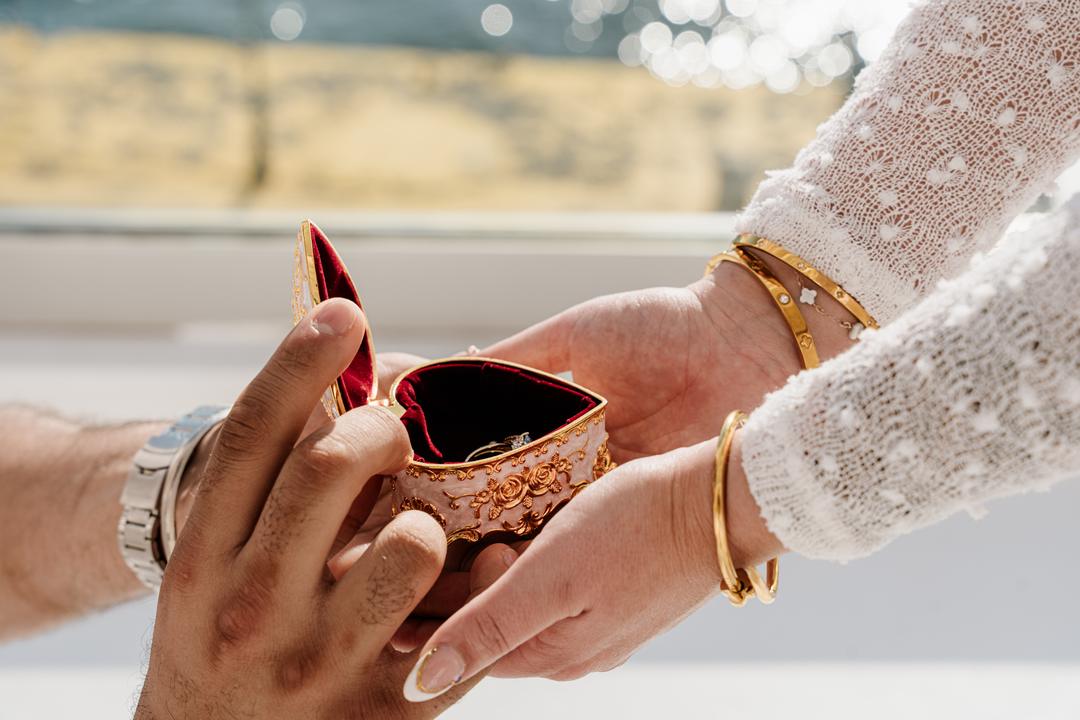
The ring has spent the whole trip perfectly safe, and then the last afternoon dissolves its routine. It is in the room safe during the wardrobe change, or in the pocket of the jacket that stayed behind, or — the quiet horror — it is present but a stone suddenly looks loose at lunch, with no jeweler between here and the question.
Custody is a protocol, not a feeling. From breakfast onward the ring has one named keeper, a fixed pocket, and a physical check at every threshold — leaving the room, entering the car, arriving at the setting. The stone gets its inspection in the morning, in good light, while a worry is still solvable. Nothing about the ring is improvised after noon.
The vendor who does not arrive
A van breaks down on the caldera road. A florist's second delivery runs long at a wedding. A musician confuses two venues with almost the same name. None of it is malice and all of it is Tuesday on a small island in season — and a plan built as a chain fails at its weakest link, an hour before the couple walks in.
So the evening is not built as a chain. Every element is layered so that no single supplier can sink the whole: the decoration has a core the planner can stage alone, music can move from the ask to the dinner, and the photographer — the one truly unrepeatable role — is protected first and doubled in planning. The question itself never waits on a van.
The moment interrupted mid-question
One knee down, and a tour group rounds the corner. A stranger raises a phone. Someone calls out congratulations before the answer has been given. Interruption is the one failure that arrives without warning, in the exact seconds that were supposed to belong to two people, and no forecast anywhere predicts it.
It is engineered against, not hoped against. The position is chosen with sightlines — backs to the approach, a natural pinch point between the couple and the path — and the timing avoids the minutes when foot traffic peaks. When someone wanders through anyway, the photographer holds, re-frames, and quietly directs a second run at the moment. The frame that matters still gets made.
Why is none of this just bad luck?
Luck is the name people give to variables they declined to measure, and almost everything that ruins a proposal evening was measurable by noon.
Wind is the clearest case. Every setting we use carries an exposure score from 1 to 5, fixed in daylight and unmoved by how much a date is worth. The Akrotiri Lighthouse sits at 5 of 5, open to every wind the Aegean owns; a yacht deck and a helicopter both carry a 4; Oia's lanes hold a 3; Pyrgos rests at a 2; a private dinner terrace is the island's 1. When the meltemi turns up, that number decides what happens next — no debate, no heroics, a lookup. Crowds are the same kind of variable: ship movements are scheduled and published, and reading them is a competence, not a gift. Ring custody is a checklist. Vendor risk is architecture. Interruption is geometry plus a clock.
None of this requires brilliance. It requires someone whose entire job is to have already thought about it — which is, compressed to one sentence, the argument for hiring a house instead of trusting the afternoon. The habits that prevent the planning-stage ancestors of these failures are gathered in the tips collection; the protocols above are what those habits look like under load.
The weather call: one owner, one deadline
A decision that belongs to everyone belongs to no one — which is how couples end up debating clouds in a hotel lobby while the light goes. So the wind call has exactly one owner: the planner physically on the island that afternoon. Not a committee, not a message thread, and not you. By design, you are the person least equipped to make it, because you are the only one in the conversation still attached to the original picture.
The call also has a deadline. It happens in full daylight, while there are still working hours to move every element to the alternate, and once made it is final. A conversion executed early is invisible; the same conversion attempted at dusk is chaos holding candles. What makes the early call possible is that the alternate already exists on paper — a named place with its own arrival time, agreed while the trip was still an itinerary, never improvised on the afternoon. That sequencing is the house's standing process rather than this page's invention, and the process page shows exactly where in the timeline it sits.
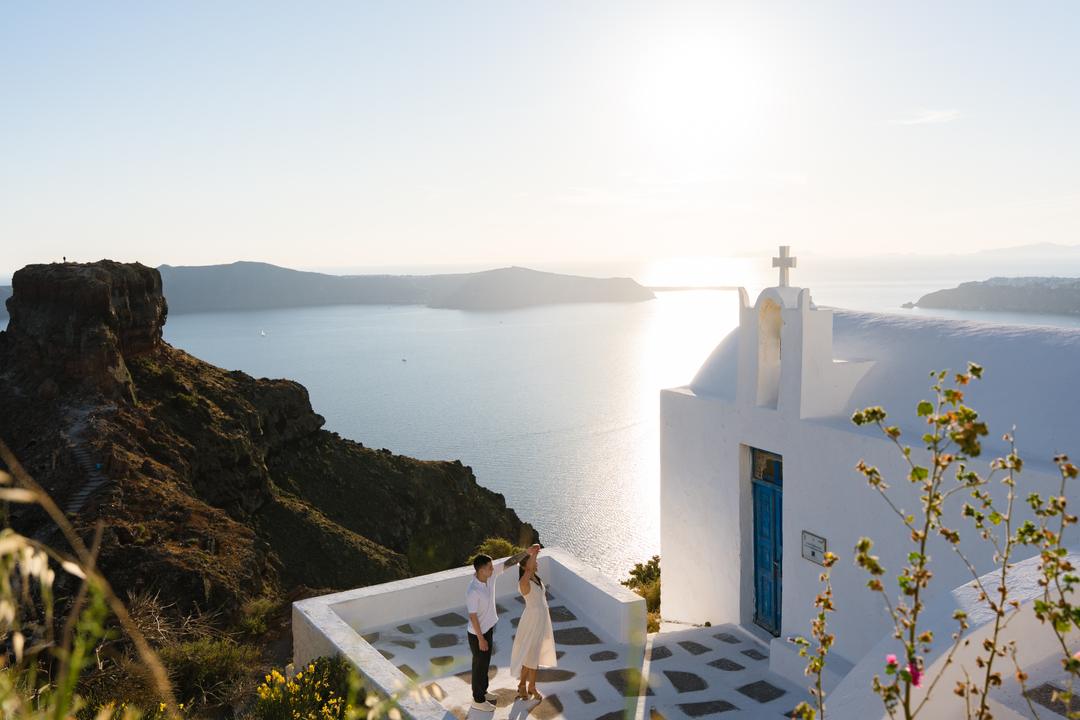
What cannot be prevented, and what honesty does about it
Some failures have no countermeasure, and pretending otherwise is its own failure mode. A drone restriction does not care how long the aerial shot has lived in your head; where the airspace says no, the answer is no, and anyone hinting otherwise is selling you a disappointment on a delay. A viewpoint can close without notice for works or a private event. And some days, rain settles over the caldera and will not lift.
What engineering offers here is not prevention but graceful degradation: a designed fallback posture for each irreducible risk, chosen while everyone is calm. The aerial shot has a ground-level twin composed from the start, so the film keeps its establishing image either way. The closed viewpoint has a neighbor the planner knows at eye level, not from photographs. The rain answer is a covered setting named ahead of the day, with the styling re-scoped to what that space can carry — a conversation the design side has early, which is why the decoration guide treats wind and weather as design inputs rather than hazards.
The honest version of this trade gets stated before you commit, not discovered on the evening. We would rather tell you at noon that something will not happen than let eight o'clock deliver the news. In our experience couples forgive weather; what they do not forgive is having been managed.
Read one way, this page is grim — five named failures and an afternoon of things going wrong. Read correctly, it is the calmest thing we publish. Every scenario above has been absorbed on real evenings by protocols that already existed, which is the only reason there are composites to write about at all. The couples standing unbothered at the rail at sunset are not the lucky ones; they are the ones whose plan had already met the wind, the ship and the van before any of them showed up. If you would rather the engineering were somebody else's job from the first message onward, that is precisely the job we are describing.
The five o'clock questions
What happens if someone walks into the middle of the question?
Almost nothing survives of it, in the version you keep. Couples describe the same sequence afterward: a jolt, a laugh neither of them planned, and then the realization a few seconds later that the answer had already been given and the stranger had missed the whole thing. What is lost is a few seconds of composure. What survives is everything the day was actually for — the question, the answer, the hands, the ring going on — because nobody stops the evening to manage an intruder and the coverage never announces that anything has happened. The board above sets out why an intrusion arrives late and from behind rather than into the middle of anything; this is what that engineering feels like from inside it. Weeks later the person who walked through has become the funny part of the story, and they are not in a single photograph.
What happens if something goes wrong with the ring on the day?
Three mishaps repeat: the ring left in the room safe after a wardrobe change, the ring in a different jacket than the person wearing it, and a stone that suddenly looks wrong a few hours out. The protocol answers all three. One person carries the ring from breakfast onward, in one agreed pocket, and confirms it by touch at every transition — leaving the hotel, getting out of the car, reaching the setting. The stone is checked in the morning, when there is still time to act on a worry. If the worst happens, the ask proceeds and the ring is presented again, properly, at dinner.
The surprise got blown this morning — is the evening ruined?
Less is lost than it feels like in the moment. What usually leaks on the morning is the fact of a proposal — a slipped word from a receptionist, a glimpse of a garment bag — not the shape of it. The where, the when, the look of the place and everything waiting there are still unknown, and those are what the evening is actually made of. Sometimes we move the ask earlier, or to a different point, so at least one element stays genuinely unannounced. A partner who suspects at breakfast and is still moved to tears at sunset is the normal outcome, not the exception.
How does the evening survive a vendor who never shows up?
By never letting one supplier hold the evening up alone. The setup has a core the planner can stage single-handed if a delivery fails, so a thinner version of the design still stands where the full one should have been. Music that misses the ask is re-sequenced into the dinner, where it lands almost as well. Transport carries margins, because caldera roads do not forgive tight timing. The photographer is the one role with no acceptable substitute on the night, so that booking is confirmed and reconfirmed on the day. What you would notice as a guest is a slightly simpler evening, not a missing one.
How does the plan handle cruise-surge days?
Ship schedules are published well ahead of any given evening, so a heavy-port day is never a surprise to the plan — only to people without one. The surge those days produce is uneven: it concentrates on Fira's cable-car corridor and thins quickly away from it, which means geography solves most of what timing cannot. On a crowded date the setting moves clear of that corridor, or the hour changes, or both. Where a famous terrace is non-negotiable, the arrival minute respects the fact that the castle terraces fill from about an hour before sunset. The plan reads the calendar so you never have to.
Tell us the date. We will hold the light.
One conversation is enough to know whether we are the right house for your proposal. No pressure, no scripts — just an honest read on your dates.
Prefer to write first? WhatsApp us at +30 694 4803339 — a planner replies, not a bot.