The flying dress, demystified
The flying dress is mechanics, not luck. Three parts: a long-trained gown, the caldera's reliable breeze, and a trained assistant who tosses the train and ducks out of frame between exposures. Sessions run about an hour, rentals cover a full size range, and jewel tones photograph strongest against whitewash and sea.
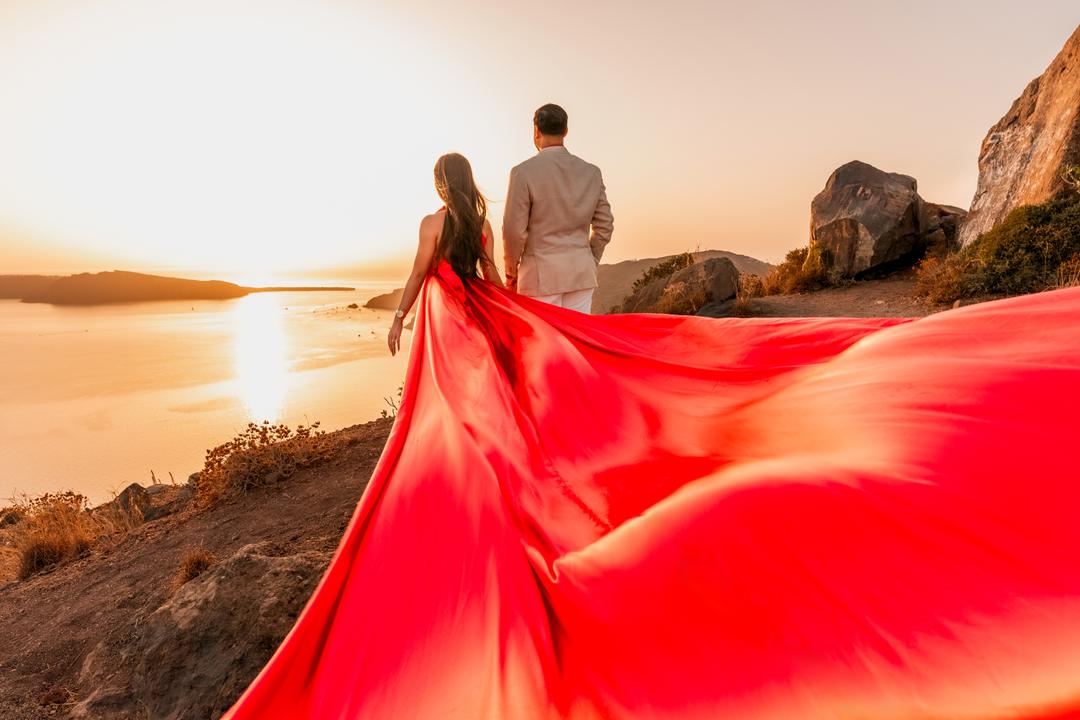
The morning after a proposal has a particular texture: coffee tastes ceremonial, the word fiancée keeps escaping in test sentences, and a hand keeps drifting into sunbeams to watch a new ring work. Into this walks a garment bag containing six meters of crimson train — and an hour later there is a photograph of you levitating fabric over the Aegean like weather. The flying dress is Santorini's signature celebration shoot, and it deserves an honest owner's manual.
Choosing the slot
| Slot | Lane traffic | Light character | Wind behavior | Verdict |
|---|---|---|---|---|
| Dawn–early morning | Empty | Soft, directional, blue-white contrast | Gentlest; the toss does the work | The professional pick |
| Mid-morning | Light | Bright, graphic, saturated | Building breeze helps the train | The comfortable compromise |
| Golden hour | The island's peak | The famous gold | Lively; big flight, less room | For drama, at terraces with space |
Session shape and where it shines
A standard session runs about an hour on location:
- gown fitted,
- a dozen toss cycles across two or three marks,
- plus quiet frames between the spectacle — those in-between images, wind settling and the two of you laughing at the sheer theater of it, age the best.
The high rims around Imerovigli give the train the drop and the room it wants; terraces work where lanes are tight. Under the gown, the practical styling rules for the partner not wearing it live in the what-to-wear guide.
Sequencing is the real secret: proposal one evening with the hidden camera, flying dress the next morning — the first act of the celebration itinerary. Couples who want a fuller portrait session around it fold the gown into a two-village engagement shoot. Book it standalone or as the classic add-on inside any package — bands published, exact quote with your dates.
Gown physics and other honest answers
How does the dress actually fly?
A person throws it. The gowns carry trains several meters long; an assistant lifts and releases the fabric on the photographer's count, the breeze does half a second of magic, and the frame is caught at the peak. Between exposures the assistant resets, again and again. On a truly still morning the toss does all the work — the photos never confess either way.
Which colors work best against the island?
Saturated ones. Reds, royal and cobalt blues, emerald, and burnt orange carry across whitewash and dark sea from fifty meters; whites and creams dissolve into the architecture, and pale pastels fade at distance. If you want one practical rule: choose the color you would never wear elsewhere. The setting is the neutral — you are the accent.
Should we book a morning or a sunset slot?
Morning for empty lanes and crisp blue-and-white contrast; sunset for gold and drama, shared with the island's busiest hour. The dress changes the calculus toward morning more than most shoots — the train needs physical room that crowded golden-hour rails rarely offer. Our default recommendation is the morning after your proposal, while the ring is still news.
Can we move between locations mid-session with the gown?
Yes, with planning: the gown travels in a carry bag, you walk in normal clothes, and changes happen at a hotel, a café's cooperation, or a parked car. One move is realistic inside a standard session; two eats shooting time. The route archetypes on the engagement-shoot page apply directly here.
Tell us the date. We will hold the light.
One conversation is enough to know whether we are the right house for your proposal. No pressure, no scripts — just an honest read on your dates.
Prefer to write first? WhatsApp us at +30 694 4803339 — a planner replies, not a bot.