The finished set, held up to the light
Good Santorini engagement photos arrive as a curated set — candid, directed and detail frames that hold together as one account of a morning. This guide describes the object itself: what each kind of frame is for, how the hour changes their color, and why the frames worth printing are the measure of the whole.
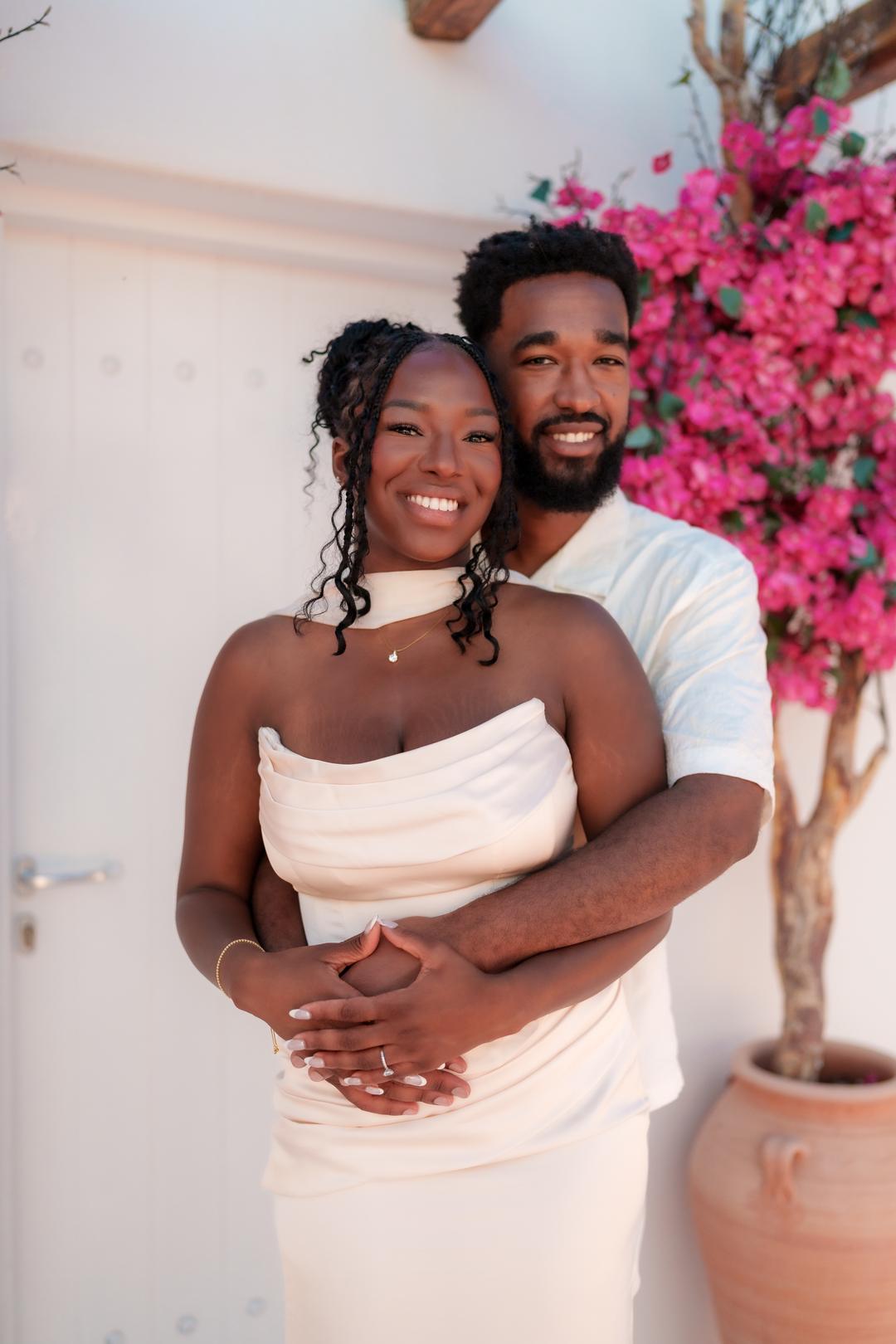
The session ends, you go find lunch, and somewhere on a memory card the morning quietly becomes an object. That object — the delivered set — is the actual product of engagement photography, and almost no one tells couples what it should contain. You are shown portfolios before you book and handed a download link after you shoot, and between those two moments sits a craft that rarely gets described: selection, sequencing, editing, and the small honest decisions about what a photograph owes to what really happened.
This page is about the photographs themselves. How the morning gets designed is the business of the engagement photoshoot guide; the eye and temperament behind the camera are weighed on the photographer page. Here we take the finished set apart: what a well-made one contains, how the shooting hour changes what arrives in it, and how to tell a set you will print from a set you will merely scroll past twice and archive.
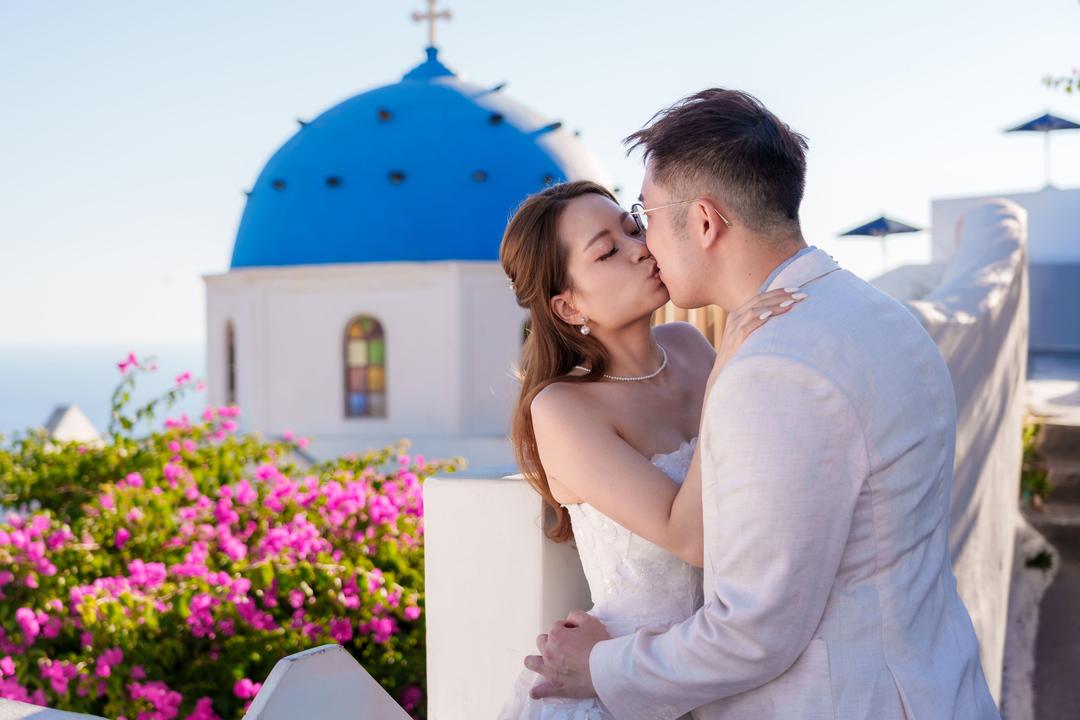
The anatomy of a delivered set
A strong set is not a pile of everything the shutter caught. It is a curated argument — measured in dozens, not thousands, to be deliberately unprecise about it — in which each kind of frame does a distinct job. When a kind is missing, you feel the absence before you can name it: the album turns repetitive, or placeless, or posed. How many dozens arrive is mostly a function of how long the session ran, which is the one lever the session tiers genuinely pull. These are the kinds, and what good looks like inside each.
The establishing frames
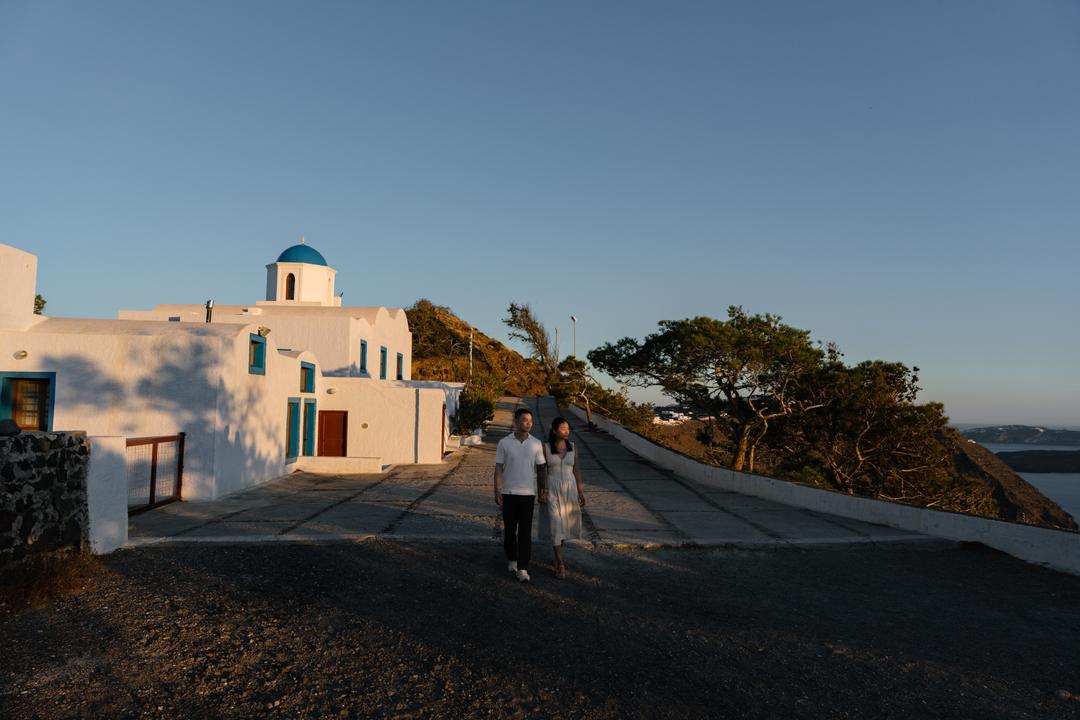
They place you: this island, this village, this hour — the frames that hold the whole setting.
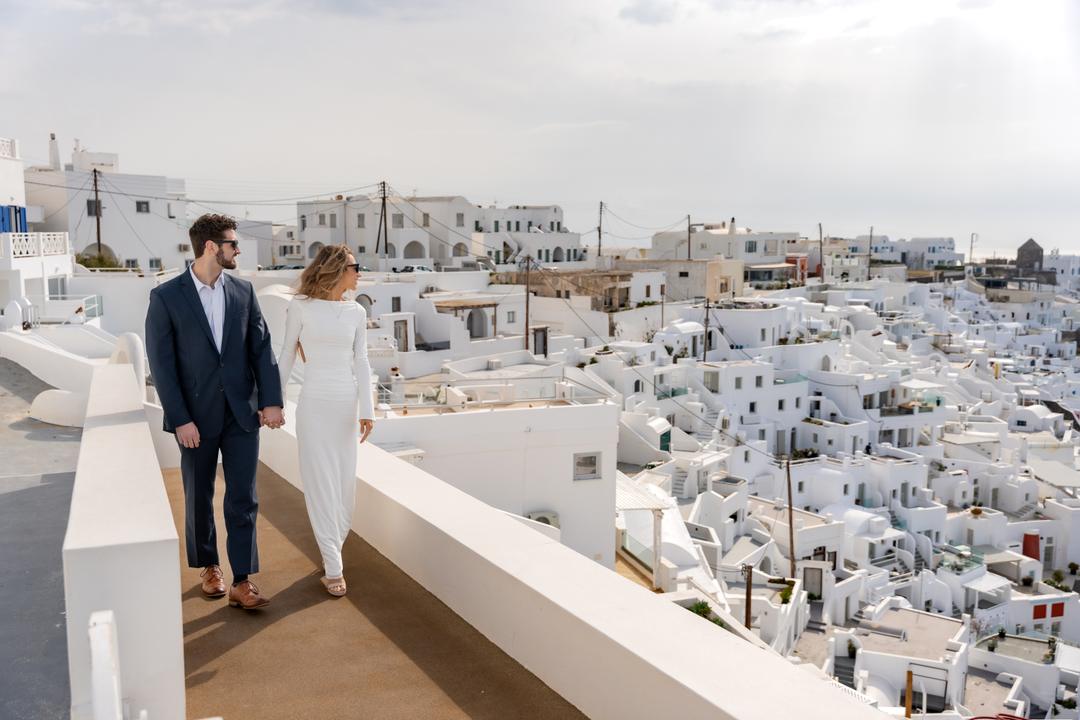
Wide compositions where you are small and the caldera is enormous. Good establishing work keeps the geography legible — you can point to the village, the rim, the water — while your figures stay findable and unmistakably you, not silhouettes that could be anyone. The light in them should describe the hour honestly. These are the frames that end up largest on walls, because they carry a place, not just a pose.
The directed frames
The composed portraits — the pictures you knew you were making while you made them.
Direction should show in the geometry, never in the faces. Good directed frames put a couple at ease inside a deliberate composition: hands resting naturally, hems behaving or billowing on purpose, the horizon level, the background chosen rather than tolerated. Stiffness is the tell of rushed work; warmth inside structure is the tell of good work. These become the spine of the album — the frames grandparents ask for.
The candids between directions
What the camera catches while you believe it is resting.
The laugh after a pose collapses, the dress being wrestled back from the wind, the glance exchanged while walking to the next mark. Good candids are sharp and composed even though nobody arranged them — proof the photographer never actually stopped working. They are usually the frames that feel like the marriage rather than the trip, and a set without them feels administered rather than lived. Their scarcity in a portfolio is worth noticing before you book.
The details
The small evidence — ring, hands, fabric, stone, the texture of the morning.
Close work: the ring against volcanic rock or whitewash, interlocked hands, a hem in motion, the coffee that started the session. Good detail frames are made with the same care as the portraits — considered light, clean backgrounds, true focus — not fired off as afterthoughts. In an album they do the connective work, giving the eye a place to rest between faces. A set without them tells a story with no punctuation.
What does the hour do to the photographs?
Couples ask about locations first, but in the finished files the hour outranks the backdrop. Golden hour — opening at 19:45 against June's 20:40 sunset, a window that moves with the month — is the flattering one: low light rakes across the caldera, whitewash turns honeyed, skin takes on warmth without any editing help, and shadows stretch long enough to give even simple lanes some drama. Frames from this window feel abundant and romantic almost by default — which is exactly why a set shot only at golden hour can blur into one long amber smear.
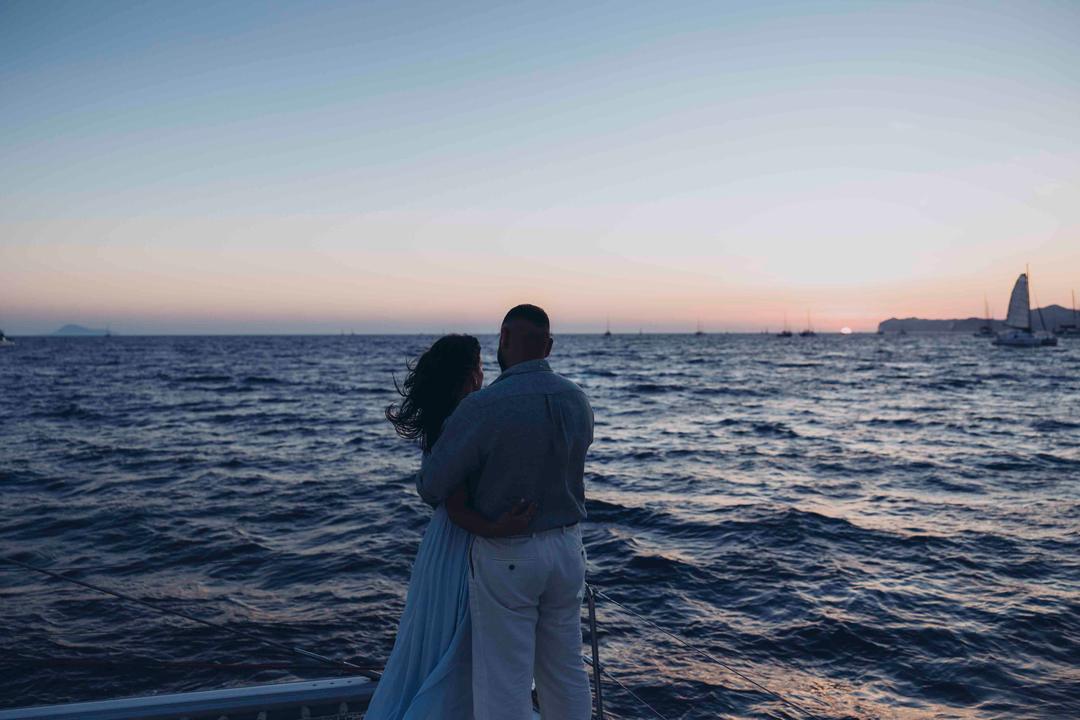
Blue hour, the short interval after the sun drops, is the calm one. The sky goes violet, the villages switch their lamps on, and the color quiets down to something intimate and slightly formal. Fewer frames come out of this window, but they are often the most atmospheric in the set — the ones that feel like a secret. Midday, which every guide warns you away from, is the honest one: hard sun, deep shadow, and the only hour when the Aegean holds its full, almost implausible blue against graphic white walls. It is a demanding light that a serious photographer uses deliberately rather than merely survives, and a token of midday work in a portfolio is a quiet mark of competence.
The hour also decides how your clothing renders — warm light flatters the terracotta-adjacent palette, blue hour deepens jewel tones, midday punishes pale pastels — so it is worth reading the outfit guide with your shooting window already in mind rather than after the wardrobe is packed.
The print test
Here is the sorting question that cuts through any gallery, your own included: which of these frames would survive being printed large? A phone screen is a generous judge — small, backlit, saturated — and it forgives soft focus, blown skies, and cluttered edges that an album page will announce loudly. Prints are the unforgiving format, which is precisely why they are the true test of the work.
Frames that survive enlargement share a construction: genuine tonal range instead of crushed blacks and seared highlights, edges that were composed rather than cropped into submission, and faces that are actually sharp rather than passably sharp. The scroll rewards color and drama; the print rewards structure. A set worth its price contains a confident handful of frames you would hang without hesitation — and if a gown was part of your session, the wide theatrical frames from a flying-dress segment are built for exactly this scale, a single moving figure against a vast ground.
So judge any delivered set by its printable core, not its total. The frames you print are the product; the frames you scroll are the pleasant byproduct. Ask a prospective photographer which images from a recent session the couple chose to print — the answer, and the speed of it, tells you how they think about permanence.
Provenance is part of the set
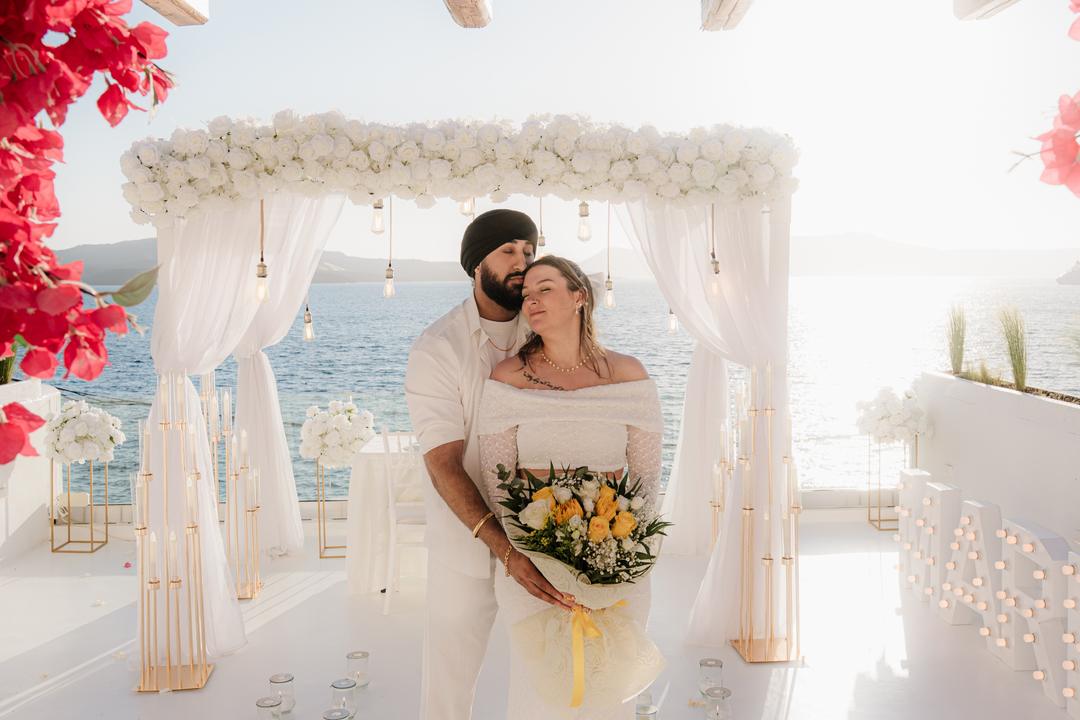
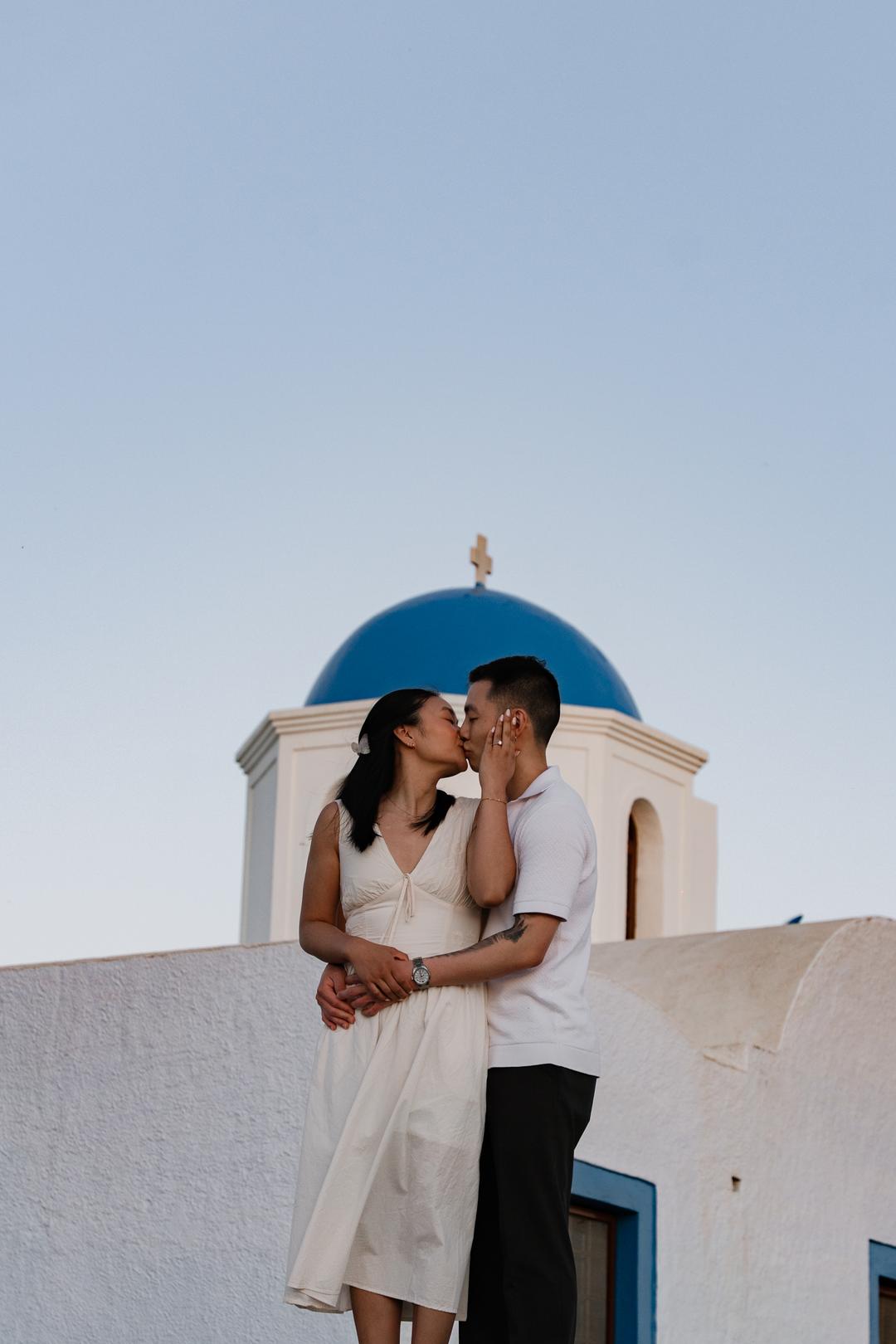
One property of a delivered set shows up in no light meter and survives no print test, and it decides whether the other three kinds mean anything: who is actually in the photographs. Every image published anywhere on this site is a real frame of a real couple, made by our team on this island, shown because that couple agreed it could be shown. Nothing here is stock, nothing is generated by a model, and nobody was hired to stand in for a client. Some of the strongest work we have made will never appear publicly at all, because the couple preferred to keep it — a set withheld on request is the same rule working as a set published on request. The gallery states it plainly and keeps it visibly.
Which turns into a question you can put to any portfolio, in three parts. Ask whether the frames are that photographer's own recent work. Ask whether the couples in them agreed to appear. Ask whether anything in them was composited or synthetically produced. Hesitation is itself an answer, because the portfolio is the promise, and a promise assembled from borrowed or invented images tells you how the rest of the engagement will be handled.
What remains, when the set is honest and well made, is a modest miracle of an object: a morning on a cliff, sorted into kinds, colored by its hour, strong enough to print — yours to keep long after the trip has faded into the story you tell about it.
After delivery, answered
What does a delivered set actually contain?
A deliberate mix of the kinds described on this page: establishing frames that hold the place, directed portraits that carry the composition, candids caught between instructions, and detail frames of ring, hands and texture. Every image in the set receives a full edit — there is no second tier of half-finished extras — and the balance among the kinds matters far more than the raw volume. A set of nothing but portraits reads as a catalog; the mix is what reads as a morning.
Should we ask for the RAW files?
Almost certainly not. A RAW file is an unfinished negative — flat, gray, deliberately dull — that needs the photographer's tools and judgment to become a photograph. Handing them over is like a chef handing you the groceries. What you actually want is the full-resolution edited set, unwatermarked and print-ready, plus a photographer willing to revisit an edit on request. The editing is a large share of the authorship; it is part of what you hired. The film side of this house answers the same question the other way, and deliberately: raw proposal footage is handed over to any couple who asks for it, because unedited clips of an unrepeatable evening are an archive, where unedited stills of a planned morning are just an unfinished picture. Stills and motion are different objects, and the split is a decision rather than an oversight.
What gets retouched, and what never does?
Honest editing works on the photograph, not on you. Color, tone, contrast and light are shaped freely; transient intrusions — a stray passerby, a sensor spot, a trash bin at the frame's edge — can go. What should never happen: bodies reshaped, skin rebuilt into plastic, or a sky swapped in from an evening that never existed. A blemish that will heal by next week may be softened; the features that make your faces yours stay untouched. The photograph remains evidence.
Can we post the photographs on social media, and how should we credit?
Yes — personal sharing is the point of having them. The usual arrangement: post freely on your own accounts, and credit or tag the photographer when you do, which costs nothing and honors the work. Confirm the edges before delivery: whether commercial or press use needs a separate agreement, and whether the photographer asks you not to lay filters over the finished files. Most do ask, because a filter on top of a considered edit quietly undoes it.
Can a photograph be re-edited after delivery?
Within reason, yes, and a good studio says so without being cornered into it. Reasonable requests: a different crop, a warmer or cooler rendering, a black-and-white version, a distraction that slipped past the first pass. What a re-edit cannot do is produce a different photograph — it refines what the camera caught, it does not replace it. Ask soon after delivery rather than years later, and point to the exact frame; specific requests get careful answers.
Tell us the date. We will hold the light.
One conversation is enough to know whether we are the right house for your proposal. No pressure, no scripts — just an honest read on your dates.
Prefer to write first? WhatsApp us at +30 694 4803339 — a planner replies, not a bot.