Santorini engagement ideas, built as sessions rather than moments
These Santorini engagement ideas are session concepts — blue hour, the flying dress, a winery, open water, inland villages — with the logistics attached. The question is already answered; what you are planning now is a shoot, so each concept below names the light window, booking reality, or transport truth that makes it work.
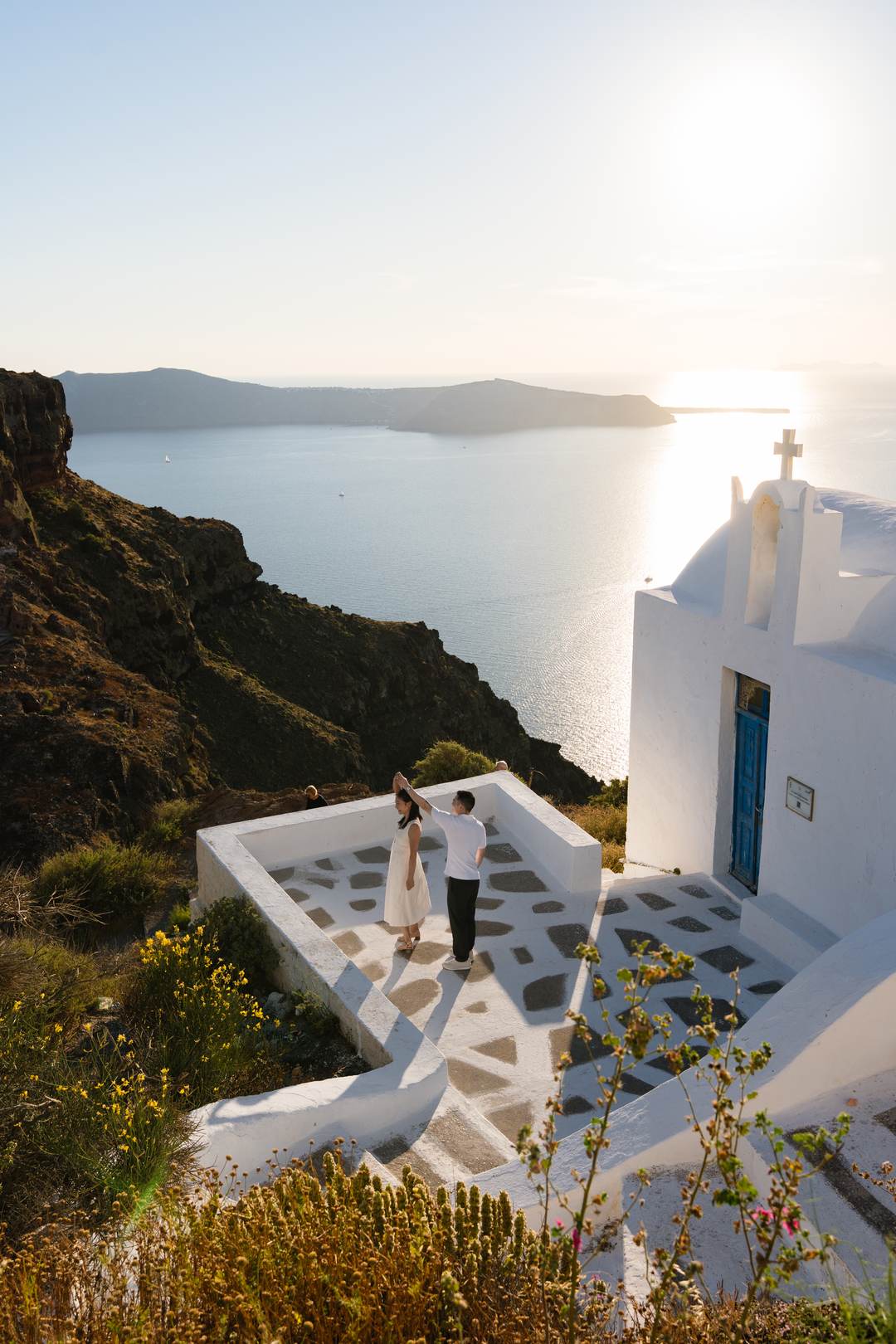
Everything on this page assumes the ring is already on. Somebody asked, somebody answered, and the shoot you are planning now carries none of the machinery a proposal needs — no cover story, no choreography of surprise, no clock running against a partner's suspicion. What replaces all of that is play. A session can chase light nobody would schedule a proposal around, borrow sets a proposal could never risk, run long because running long is enjoyable, and stop for lunch. It still repays planning, though: the island hands its best frames to couples who arrive at the right hour, by the right road, with the right booking made.
One boundary, stated plainly. Ideas for the asking itself — settings, formats, budgets for the moment of the question — live on the proposal ideas page. This page owns the engagement session: the shoot you book once the answer already exists, whether that is the morning after a yes on the island or a trip planned around photographs from the start. Five concepts follow, and each travels with the single logistical truth that makes or breaks it.
Five concepts, each with its deciding fact
Blue hour
The window opens the moment the sun is fully down and closes fast — in June that means a 20:40 drop with color holding to about 21:15, and by September the drop slides to 19:30.
Most sessions end at sunset; this one begins there. The sky deepens to cobalt, the whitewash holds a soft ambient glow, and the village lights come up like set dressing nobody billed you for. The light is even and kind to faces, and the lanes that were packed an hour before are suddenly walkable. It is the island's most flattering light and its least contested.
The flying dress
The dress is rented and fitted before shoot day, and the concept needs wind — a dead-calm evening grounds it.
A single frame of engineered drama: a long hem thrown seaward off a terrace edge while you stand still at the center of the motion. It photographs like couture and books like a rental, and it has become the island's signature engagement image for good reason. Accept that it is a produced shot rather than a candid one, then commit to it completely; colors, fittings, and locations are covered on the flying dress page.
The winery session
Tasting rooms are working businesses that shoot around service — the conversation with the venue comes before anything else is booked.
Vaulted cellars, barrel rows, dark volcanic stone, and a glass of assyrtiko that gives your hands something honest to do. The textures are everything the caldera is not — warm, grained, shadowed — which is why these frames stand apart in an album full of white and blue. Late afternoon puts low gold light on the vine terraces outside. Venues that welcome a camera are mapped on the winery page.
On the water
Charters answer to the forecast before they answer to you — hold the date loosely and let the captain confirm it.
A deck gives you a set no terrace can copy: the cliffs from below, a horizon with nothing on it, and a backdrop that keeps changing while you stand still. Wind does the styling, sea light does the color work, and the two of you hold the entire frame. Routes, swim stops, and golden-hour returns are detailed on the yacht page.
The inland set
Pyrgos, Emporio, and Megalochori ask for a car and unhurried time — the reward is lanes with almost nobody in them.
Not every frame needs the caldera behind it. The inland villages offer shadowed passages, carved doorways, and bell towers against open sky, and the middle of the day — unusable on the rim — works here because the lanes manufacture their own shade. Add the sculpted white cliffs of the south coast for something severe and cinematic, and the album gains a register the rim alone cannot supply.
What does a session change, now that nothing is secret?
Almost everything about how the hours feel. Proposal photography is documentary by necessity: the frames are caught rather than built, and nothing can be repeated. A session inverts every one of those constraints. The photographer directs openly, you can run a moment again because the wind ruined it the first time, you can review frames mid-shoot and adjust, and you can change outfits between locations because the day was designed with a second look in mind. Scheduling flips, too: instead of bending the plan around a partner's expectations, you bend it around light — a start time chosen for the sun rather than the dinner reservation. What carries over from the proposal craft is the logistics discipline: routes walked in advance, backup positions for wind, a plan for crowds. The practical spine of a session — how long one runs, how routes are designed, how and when the photographs arrive — is laid out on the engagement photoshoot page; this page stays at the level of the concept, the argument for each set before you commit to one.
Reading the light like a session planner
The island runs on a simple daily cycle, and sessions that work are built with it rather than against it. Morning belongs to couples who dislike an audience: lanes still empty, air still cool, the light low and gentle. Midday is harsh on the rim and generous inland, where the village lanes shade themselves; that is the hour to be in Pyrgos, in a cellar, or at lunch. Golden hour remains the marquee slot and behaves like one — every terrace, path, and rail on the caldera fills for it, so a golden-hour session earns its frames through position and patience. Blue hour is the encore most visitors never stay for, and the reason it leads the board above. None of this requires guesswork: sunset minutes are published on the sunset table, and a session plan is that table read backward — be here by then, move there when the light turns, finish where dinner starts.
Wardrobe, roads, and the unglamorous middle
Three practical notes decide more sessions than any concept choice. Wardrobe: bring a second look and shoes you can walk cobbles in; long fabric loves the wind and the wind knows it, so anything flowing should be pinned, weighted, or chosen because it moves well. Roads: distances on the map lie — village lanes are pedestrian, parking sits at the edges, and moving between sets takes longer than the drive itself, so a session day budgets transit as generously as shooting time. Water: the caldera has almost no shade and the summer sun is sincere; carry it and drink it. None of this is glamorous, and all of it shows in the frames as the difference between a couple at ease and a couple enduring.
Stacking concepts into one day
The concepts combine well, provided each keeps its own light window. A winery afternoon flows naturally into a blue-hour finish — cellar and vines in the low sun, then a caldera village as the lights come on. A morning on the water pairs with an inland lunch and leaves the evening free. The flying dress works best as the closing act of a golden-hour slot, when the wind is reliable and the light at its warmest. What rarely works is compression: three concepts forced into a single evening produce a session that is all transit and no play. Choose one anchor concept, give it the best light of the day, and let a second ride along only if the geography cooperates. Where each backdrop actually sits — village by village, coast by coast, with the honest crowd picture for each — is ranked on the engagement spots guide, this page's sibling and its natural next read.
Booking a session: five honest answers
What is a blue-hour session, and why does it flatter?
It is a shoot that starts where most others stop — in the stretch after sundown when the sky deepens to cobalt and the village lights come on. The light is even and directionless, so faces read soft and nobody squints into a low sun. Terraces clear as diners sit down, which hands you clean frames in places that were crowded an hour earlier. Count backward from the published sunset minute and be in position early.
How does a winery session actually work as a set?
Two rooms, two moods. The tasting terrace gives low gold light over vine rows; the barrel cellar gives dark stone, curved shadow, and texture the whitewash cannot offer. Because tasting rooms serve paying guests, the shoot is arranged with the venue in advance — quieter hours, a reserved corner, glasses poured for the frame and the toast alike. The result resembles no caldera session, which is exactly its value.
What does a session on the water give that a terrace cannot?
Angle and emptiness. From a deck the cliffs rise above you instead of dropping away beneath, the horizon carries nothing built by anyone, and no other party shares the set. The trade is control: the sea keeps the schedule, and a rough forecast can move your date by a day. Couples who accept that trade bring home frames a land session cannot imitate.
Are backdrops away from the caldera worth a session?
Often the strongest day in the album. Pyrgos, Emporio, and Megalochori offer shaded lanes, carved doorways, and bell towers with almost nobody passing through, and they work in the middle hours when rim light is at its harshest. The sculpted south coast adds something stark and geological. Together they give the set a range that caldera frames alone never reach.
How do we match a concept to the two of us?
Ask how the two of you behave on camera when nothing is at stake — because now nothing is. Couples who warm up slowly suit a long inland or winery session; couples who enjoy being directed suit the flying dress; restless couples belong on a deck. That is session energy, a different question from the temperament math of deciding how to ask — the pressure behind that math is gone.
Tell us the date. We will hold the light.
One conversation is enough to know whether we are the right house for your proposal. No pressure, no scripts — just an honest read on your dates.
Prefer to write first? WhatsApp us at +30 694 4803339 — a planner replies, not a bot.